Search This Blog

Monday, July 19, 2021

Tennessee Biology Standards

 The following information comes from

https://www.tn.gov/content/dam/tn/stateboardofeducation/documents/massivemeetingsfolder/meetingfiles4/10-20-17_III_J_Non-Substantive_Changes_to_Math_ELA__Science_Standards_Attachment_3_-_Science.pdf (2020/07/19)

beginning on page 58 and following…


BIOLOGY I: COURSE OVERVIEW

The academic standards for High School Biology I establish the content knowledge and skills for Tennessee students in order to prepare them for the rigorous levels of higher education and future job markets. The course provides students with a wealth of experiences for both science practices and content knowledge needed in an ever changing world. The academic standards for Biology I are research-based, supported by the National Research Council’s Framework for K-12 Science Education, and establish the core ideas and practices of science and engineering that will prepare students to use scientific thinking to examine and evaluate knowledge encountered throughout their lives.

The major disciplinary core ideas utilized for Biology I include:

Biology I (BIO1)

Life Sciences (LS)

Engineering, Technology, and Applications of Science (ETS)

From Molecules to Organisms: Structure and Process

  • Organic molecules

  • DNA structure and function

  • Protein synthesis

  • Protein structure and function

  • Cellular differentiation and

    coordinated functions

  • Eukaryotic cell cycle

  • Membrane transport

  • Photosynthesis and respiration

Engineering Design

Ecosystems: Interactions, Energy, and Dynamics

  • Population dynamics

  • Carbon cycle

  • Energy transfer

  • Succession

  • Biodiversity and ecosystem stability

Links Among Engineering, Technology, Science, and Society

  • Molecular biotechnology applications

  • Ethical debates of biotechnology use

Heredity: Inheritance and Variation of Traits

  • Sexual reproduction

  • Phenotype determining factors

  • Pedigree analysis and predictions

Applications of Science

Biological Change: Unity and Diversity

  • Evidence for evolution

  • Natural selection

  • Evolutionary processes

  • Speciation

  • Global biodiversity patterns

  • Human activities that impact

    biodiversity

58

Although science is a body of knowledge consisting of theories that explain data, science is also a set of

practices that use analysis and argumentation to establish, extend, and refine knowledge. The s

These practices are not

intended to be a sequence of steps nor are they intended to be taught as a separate, introductory unit

for the course.

and engineering practices are used as a means to learn science by doing science.

By combining content knowledge with skill, students discover how scientific knowledge is acquired and applied to solve problems or advance scientific knowledge further. In addition, there are seven crosscutting concepts that

and crosscutting concepts, within each core idea to provide students with a

well-rounded education in science.

Tennessee's state mathematics standards are integrated into the science standards, specifically LS3.3. Special attention is given to science literacy through the use of the science and engineering practices. Students are required to gather information from reliable sources to construct evidenced-based arguments. Finally, STEM integration is supported both as a stand-alone disciplinary core idea as well as integrated into the life science core ideas. By the end of high school, it is expected that all students should be able to demonstrate the skills and content knowledge emphasized in the following standards.

are fundamental to the nature of science and thus stretch across all

cience

science disciplines. The Biology I standards have been constructed by explicitly integrating practices

iteratively and in combination,

59

BIOLOGY I: ACADEMIC STANDARDS

BIO1.LS1: From Molecules to Organisms: Structures and Processes

1) Compare and contrast existing models, identify patterns, and use structural and functional evidence to analyze the characteristics of life. Engage in argument about the designation of viruses as non-living based on these characteristics.

2) Evaluate comparative models of various cell types with a focus on organic molecules that make up cellular structures.

3) Integrate evidence to develop a structural model of a DNA molecule. Using the model, develop and communicate an explanation for how DNA serves as a template for self-replication and encodes biological information.

4) Demonstrate how DNA sequence information is decoded through transcriptional and translational processes within the cell in order to synthesize proteins. Examine the relationship of structure and function of various types of RNA and the importance of this relationship in these processes.

5) Research examples that demonstrate the functional variety of proteins and construct an argument based on evidence for the importance of the molecular structure to its function. Plan and carry out a controlled investigation to test predictions about factors, which should cause an effect on the structure and function of a protein.

6) Create a model for the major events of the eukaryotic cell cycle, including mitosis. Compare and contrast the rates of cell division in various eukaryotic cell types in multicellular organisms.

7) Utilize a model of a cell plasma membrane to compare the various types of cellular transport and test predictions about the movement of molecules into or out of a cell based on the homeostasis of energy and matter in cells.

8) Create a model of photosynthesis demonstrating the net flow of matter and energy into a cell. Use the model to explain energy transfer from light energy into stored chemical energy in the product.

9) Create a model of aerobic respiration demonstrating flow of matter and energy out of a cell. Use the model to explain energy transfer mechanisms. Compare aerobic respiration to alternative processes of glucose metabolism.

60

BIO1.LS2: Ecosystems: Interactions, Energy, and Dynamics

1) Analyze mathematical and/or computational representations of population data that support explanations of factors that affect population size and carrying capacities of populations within an ecosystem. Examine a representative ecosystem and, based on interdependent relationships present, predict population size effects due to a given disturbance.

2) Create a model tracking carbon atoms between inorganic and organic molecules in an ecosystem. Explain human impacts on climate based on this model.

3) Analyze through research the cycling of matter in our biosphere and explain how biogeochemical cycles are critical for ecosystem function.

4) Analyze data demonstrating the decrease in biomass observed in each successive trophic level. Construct an explanation considering the laws of conservation of energy and matter and represent this phenomenon in a mathematical model to describe the transfer of energy and matter between trophic levels.

5) Analyze examples of ecological succession, identifying and explaining the order of events responsible for the formation of a new ecosystem in response to extreme fluctuations in environmental conditions or catastrophic events.

BIO1.LS3: Heredity: Inheritance and Variation of Traits

1) Model chromosome progression through meiosis and fertilization in order to argue how the processes of sexual reproduction lead to both genetic similarities and variation in diploid organisms. Compare and contrast the processes of sexual and asexual reproduction, identifying the advantages and disadvantages of each.

2) Explain how protein formation results in phenotypic variation and discuss how changes in DNA can lead to somatic or germ line mutations.

3) Through pedigree analysis, identify patterns of trait inheritance to predict family member genotypes. Use mathematical thinking to predict the likelihood of various types of trait transmission.

BIO1.LS4: Biological Change: Unity and Diversity

1) Evaluate scientific data collected from analysis of molecular sequences, fossil records, biogeography, and embryology. Identify chronological patterns of change and communicate that biological evolution is supported by multiple lines of empirical evidence that identify similarities inherited from a common ancestor (homologies).

61

2) Using a model that demonstrates the change in allele frequencies resulting in evolution of a population over many generations, identify causative agents of change.

3) Identify ecosystem services and assess the role of biodiversity in support of these services. Analyze the role human activities have on disruption of these services.

BIO1.ETS2: Links Among Engineering, Technology, Science, and Society

1) Obtain, evaluate, and communicate information on how molecular biotechnology may be used in a variety of fields.

2) Investigate the means by which karyotypes are utilized in diagnostic medicine.

3) Analyze scientific and ethical arguments to support the pros and cons of application of a specific biotechnology technique such as stem cell usage, in vitro fertilization, or genetically modified organisms.


Wednesday, April 14, 2021

Overview of Balancing Nuclear Reactions

General Chemistry Index

Where are we going with this? This page will assist in developing the ability to compare and contrast nuclear reactions with chemical reactions and to describe nuclear changes in matter, including fission, fusion, transmutations, and decays.


Overview of Balancing Nuclear Reactions

We're going to stick to the big picture… This really isn't that difficult!

But, it IS hard to type, especially in a web page! Therefore, there's going to be a slight adaptation to normal notation methods.

_____________

The hand-drawn image below is "typical" notation. 

Figure 1 is a uranium with 235 mass and 92 protons. (If it had a different number of protons, it wouldn't be uranium. This means it has 235 - 92 neutrons. Which is 143 neutrons.


Figure 2 is plutonium with a mass of 214 and 84 protons.


Hereafter in this article, the symbols will be typed like this: 

23592U                21484U


_____________

Okay… about balancing nuclear reactions.

Well, the principle is pretty easy, and if we define one more term it gets easier!

A nucleon is a proton or a neutron (since they both normally reside in the nucleus).

You will recall in normal chemical equations, because of the Law of Conservation, the total number of each type of atom from the reactants can be found in the products.

The Law of Conservation is seen, too, in nuclear reactions. However, the inventory is no longer types of atoms, but is nucleons. 

Furthermore, in nuclear reactions, we talk about, not reactants and products (though the concept holds) but rather parent nucleus and daughter nucleus (and yeah… sometimes, "products" will be used, too, when some of the thing produced are not atoms.).

In nuclear reactions, the number of protons in the atoms change. Therefor, the "atom inventory" will not be the same. However…

…in nuclear reactions, the number of nucleons in the parent is the same as those found in the products.

That's it!

So, in balancing nuclear reactions, the masses (top left) and number of protons (bottom left) will always "add up."


Let's say you have three "things" called X, Y, and Z… These could be any kind of atoms or particles.

And let's use a, b, and c for the number of protons and A, B, C for the masses…


So balancing… let's say we do fusion taking an X and Y and making a Z. The balanced equation would fit this form:

AaX     +    BbY    →  A+Ba+bZ


Now, go back and look again! See how the mass of Z is the sum of the masses of X and Y? See how the proton number of Z is the sum of the proton numbers of X and Y? How 'bout some color?

AaX     +    BbY    →  A+Ba+bZ


Stop and look again! Seriously! This is really easy!


Okay, so… in a lot of nuclear reactions, there's one thing to start with and it comes apart (decay, fission).

That means the numbers in the products add up to the numbers you started with. If you have a pack of 10 cupcakes that weigh a total of 50 ounces each, and you split it into two bags, each bag will have 5 cupcakes and weight 25 ounces.

When the parent breaks apart it looks like this…

 A+Ba+bZ   →   AaX     +    BbY 


Still, not too bad!

You should also keep in mind that there are a few cases where more than one of a certain thing results. As in regular chemical reactions, if more than one of a particular thing is involved, a coefficient will be put in front. It will have the effect of multiplying whatever it proceeds.

So,

2  42α 

would mean 4 protons and a mass of 8.


One last thing… Some sources will NOT include the proton number in their equations. You might see this, but you can track that based on the atomic symbols.

For instance…

226Ra → 222Rn + 42α

Because the atomic symbol is Ra, we know that there are 88 protons. Similarly, because it is Rn, we know that there are 86 protons. Having them included, though, makes the conservation more obvious.


______________

Okay, some real examples from here:


Alpha decay


The mass and atomic number (proton count) both decrease because an alpha particle has 2 protons and 2 neutrons.


Beta decay


A neutron emits a ß particle (massless, "negative proton" / electron) so the mass stays the same but the atomic number (proton count) increases.


Positron Emission


A proton emits a mass-less positron, so the mass stays the same. The proton becomes a neutron, though, reducing the proton count (atomic number) by one


Electron capture


A proton captures an electron, becoming a neutron. Hence, the mass number stays the same, but the atomic number (proton count) decreases. Also, x-ray radiation is produced.


Gamma ray emission


In this example, U-238 decays into "excited" Th-234 which then "relaxes" and gives off gamma rays. Notice that the mass and proton count is equal in all three phases of the reaction because the alpha particle in the middle phase "leaves" the process and never appears in the third phase.


______________

SUMMARY:

In nuclear reactions:

  • The total mass and number of protons will be the same in all stages of the reaction.

  • Changing the number of protons changes the atomic number; the types of elements are NOT the same.

  • If more than one of a particular thing is involved, a coefficient will be put in front. It will have the effect of multiplying whatever it proceeds.


Tuesday, April 13, 2021

Types of Nuclear Reactions

General Chemistry Index

Where are we going with this? This page will assist in developing the ability to compare and contrast nuclear reactions with chemical reactions and to describe nuclear changes in matter, including fission, fusion, transmutations, and decays.


Types of Nuclear Reactions

Reactions in the nucleus can take numerous forms. We should define them!

But first… A term you might encounter that you need to recognize! Nuclear reactions produce a transmutation of the element or elements involved. Transmutation is the conversion of one element into a different element as a result of changes to the number of protons in the nucleus. Transmutations can occur either spontaneously or they can be induced.

What causes nuclear reactions?

Source

We're going to stay in the shallow end of the pool for this…
So… There are, within the nucleus two forces playing push-me-pull-me. Nuclear forces between the subatomic particles hold the nucleus together. BUT! The repulsive electromagnetic (opposites attract, like repel) forces of all those protons try to hold the nucleus together. 

So, one example would be if you kept jamming more and more protons into the nucleus. The nuclear attractive forces keep trying to hold them together but the repulsive electromagnetic forces keep "pushing against" the nuclear force. Now, think of the nuclear force as a spring. Which eventually snaps! BLAM! The whole thing flies apart all at once!

The attractive nuclear force, called strong nuclear, operates only at very, very small distances. The repulsive electromagnetic force operates at much, much larger distances. Thus, the bigger the nucleus, the less affect the strong nuclear force can produce. At some point the strong nuclear "spring breaks" and everything goes flying!

There are many nuances to this! But, at the most basic level, nuclear reactions occur because of instability in the nucleus of an atom caused when the repulsive electromagnetic forces becomes greater than the attractive strong nuclear forces.

It's important to note that not all changes to the nucleus result in an unstable atom. Remember isotopes? So, for instance, you can jam a neutron into hydrogen and get a stable isotope. But if you keep jamming them in, eventually it becomes unstable.


Types of Nuclear Reactions


Fission is the splitting of the nucleus of a very heavy element into two—sometimes three—smaller nuclei. Fission can occur spontaneously, but that is, according to some paradigms, not considered a nuclear reaction. Fission can be induced by adding additional particles (usually neutrons) until the element  becomes "overloaded" and unstable.

By adding neutrons, the size of the nucleus increases until, at some point, the distance between particles is greater than that which strong nuclear forces can be effective resulting in the splitting of the nucleus.

Fission reactions produce energy.


https://www.energy.gov/science/doe-explainsnuclear-fusion-reactions

Fusion
is the combining of two or more atoms of small element into one or more different atoms.
 

For example, two hydrogen isotopes, H-2 and H-3 (sometimes called "heavy hydrogen"), can be jammed together to produce helium, energy, and a neutron.

Fusion is the process that happens within the sun. Fusion requires a great deal of energy to initiate, but once it begins, it produces even more energy. Hence… the sun… and stars…


Alpha Decay is the emitting of alpha particles from the nucleus of an atom causing the original atom to decay or transform into a different atom—an atom with a mass 4 less than the original and an atomic number 2 less. 

Alpha decay occurs spontaneously in some elements. It can also result from induced reactions.

Noteworthy is the practice of ignoring the electrons in nuclear reactions. The alpha particle is identical to a helium atom without electrons. That's to say it has an ionic charge of -2. The atom left behind ends up with two extra electrons! So… what happens.

Once more, in this introduction, we'll stick to the shallow end of the pool. Since most considerations of nuclear chemistry do not deal with the electrons, we'll be okay!

Summing up a lot of sources, the left-behind electrons will eventually stabilize; they find some place to go. For instance, in metals, they can join the conduction band. As for the emitted particle, it can pick up electrons from the environment and become a stabilized helium atom.

So, on a universal scale, the electrons all find a home, eventually. 

It is further noteworthy to consider what happens when the alpha particle contacts… say a person… before becoming stable. The charged, heavy, fast moving alpha particle will try to stabilize as fast as it can. If ingested, inhalied, or injected into living cells, there is an increased chance of breaking the double-strands of the DNA. This leads to numerous medical considerations and applications. Source


Source

Beta Decay
is the emission of a ß- beta particle from nucleus of an atom.
Beta decay occurs when the nucleus becomes unstable  due to having too many neutrons. 

In beta decay, a ß- beta particle is emitted from a neutron, converting the neutron to a proton and increasing the atomic number of the element by 1. However, the atomic mass of the element stays the same. 


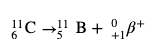
Positron Emission is the emission of a positron from the nucleus of an atom. It occurs when there are not enough neutron (relative to the number of protons) to keep the nucleus stable.

In positron emission, a proton emits the ß+ positron, converting it into a neutron. This decreases the atomic number by 1, but does not change the atomic mass.


Electron Capture is the process by which, in a neutron-poor atom, an electron reacts with a proton to produce a neutron. This occurs in order to stabilize the atom's nucleus.

The conversion of  the proton to a neutron does not change the atomic mass, but it does decrease the atomic number by 1.

Electron capture additionally results in the emission of x-ray radiation.


Gamma Ray Emission is emission of high-energy electromagnetic radiation in the form of γ rays (gamma rays) from the nucleus of an atom.

Gamma ray emission are energy, so they do not affect either the mass number or atomic number of element(s) involved in the reaction.


Spallation occurs when a nucleus is hit with enough energy to cause some neutrons and/or protons to be broken free and emitted.


Monday, April 12, 2021

Nuclear Chemistry Notation

General Chemistry Index

Where are we going with this? This page will assist in developing the ability to compare and contrast nuclear reactions with chemical reactions and to describe nuclear changes in matter, including fission, fusion, transmutations, and decays.


Nuclear Chemistry Notation

Okay, so, in nuclear chemistry, we are messing around inside the nucleus. Meaning we can change things up! Meaning not all of an element will have the same atomic mass! Isotopes and all that…

To show a more detailed picture of what is present within a particular atom, nuclear chemistry uses a more detailed means of notation.

http://hyperphysics.phy-astr.gsu.edu/hbase/Nuclear/nucnot.html

There are three parts to the nuclear chemistry notation: The atomic symbol, the number of protons, and the total atomic mass.

And, it's hard to type! Sorry…

The notation consists of the atomic symbol written in "normal" size. At the top, left, is the total atomic mass much smaller. At the bottom left is the number of protons written much smaller.

I find it interesting that the number of protons dictates what the atomic symbol is. If the number of protons changes, the symbol changes, too. But, the number of protons and atomic mass have to be attached to something, so the atomic symbol makes sense.

I sort of think you could leave off the proton number, BUT!!!! when you start doing the reactions, it's really, really handy to have them noted already!

In the image below, you'll see a few examples.

Figure 1 is a uranium with 235 mass and 92 protons. (If it had a different number of protons, it wouldn't be uranium. This means it has 235 - 92 neutrons. Which is 143 neutrons.

Figure 2 is plutonium with a mass of 214 and 84 protons.


They are sometimes typed like this: 

23592U                21484Po


In future articles, the above typed format will be used.

_______________

There are also a couple of special symbols.

Those alpha particles…

So, it's a He atom without electrons… It has a mass of 4 and has 2 protons. So… Yeah… Some sources will indicate them (in a way that can be typed) as…

He2+

…which makes sense. But, does not follow the normal notation system above, which is really, really handy when it come to the whole reaction thing.

So, there are two ways you'll often see the alpha particles notated for the purposes of nuclear reaction notation:


42α                42He

Both the 𝞪 and the He show the 4 and 2 for the mass and number of protons. However, with the He, it is not obvious that the electrons are missing. With the 𝞪 it is more certain. 

Some sources will use the 𝞪 by itself without the mass/proton numbers. Now you know…


_______________

Those beta particles…

Recalling that we have two types of beta particles, we would expect two ways of notating them. Well…

Again, at a simple level, we can consider the negatively charged beta particle to be an electron. For the purposes of basic nuclear reaction concepts, this is acceptable. Thus, the ß- particle can be written the four ways shown in the image below:


e-       0-1 ß          ß-        0-1e


All of these notations represent an electron separated from an atom.

Looking at the second and fourth symbols above in light of the normal notation, it makes sense. The top number is atomic mass and the bottom number is how many protons. So, because it is an electron, it's a "negative proton" with a mass of zero. That makes sense, right? 


The other beta particle (a positron) has a positive charge. Thus, the ß+ particle, can be written the two ways shown in the image below:


 0+1 ß          ß+ 

In light of normal notation, then, it is a "massless" proton? Sort of? Just trying to connect ideas, here… 

This particle is not seen often in introductory examples, but the notation is simple.


_______________

Protons and neutrons…

No surprise here! Thankfully. The proton symbol is a "p" with a 1 at the top and bottom on the left, which means it has a mass of 1 and includes 1 proton. The neutron symbol is an "n" with a 1 at the top and a 0 at the bottom on the left.

Figure 1 below shows the notation for protons.
Figure 2 below shows the notation for a neutron.


11p                11n


_______________

Gamma rays

Some reactions will produce electromagnetic gamma ray radiation. The symbol for this is a greek letter, gamma:

γ

_______________

So what?

Source
Nuclear chemistry notation is the vocabulary for nuclear reactions. So, when we start with some stuff and slam some more stuff into it, then stuff shoots out, we have a way of describing it.

Whereas each symbol sort of seems confusing seen alone, when put into a reaction, all the "up numbers" and "down numbers" will add up nicely.

It's actually a really, really handy notation system!


Nuclear Chemistry Definitions

General Chemistry Index

Where are we going with this? This page will assist in developing the ability to compare and contrast nuclear reactions with chemical reactions and to describe nuclear changes in matter, including fission, fusion, transmutations, and decays.


Nuclear Chemistry Definitions

So, if nuclear chemistry is the study of chemical reactions dealing with changes and transformations in the nuclei of atoms, we need to get some basic definitions down so we are sure what we are talking about!

Let's start with the very basics.

Atom: the most basic particle of matter made of protons, neutrons, and electrons.

Neutron: neutrally charged particles that make up atoms and which are found in the nucleus of the atom. Has a mass of about 1.

Proton: positively charged particles that make up atoms and which are found in the nucleus of the atom. Has a mass of about 1.

Electron: negatively charged particles that make up atoms and which are found in orbital (having fixed, specific energy levels) outside the nucleus of the atom. Has a very, very small mass compared to neutrons and protons.


Element: a specific type of matter defined by how many protons are present in the nucleus of its atom. Each element has a different atomic number.

Atomic number: the number of protons present in the nucleus of an atom.

Changing the number of protons changes the atomic number and, therefore, changes the name of the element!


Atomic Mass/Weight: The sum of the masses of all the parts of an atom (essentially, the protons and neutrons, since electrons have so little mass).

_______________

What happens if you change the number of neutrons in an atom?

Changing the number of neutrons changes the atomic mass of the atom. But, if the number of protons stays the same, it is the same element (by definition).

Isotope: A form of an atom having a non-typical mass because of the presence or absence of some number of neutrons.

Suppose you jam a neutron into hydrogen. The number of protons is still 1, but the mass is now 2. This is an isotope of hydrogen called deuterium. 

_______________

What happens if the number of protons and electrons are not the same?

Yeah, that can happen. 

It's fair to consider that an ion. 

Ion: a molecule/atom having a net positive or negative charge due to having too many or too few electrons (as compared to the number of protons).


_______________

So, armed with the above vocabulary, we can go on with all this nuclear chemistry stuff! But… since all the numbers seem to be subject to changing, we probably need some way of keeping up! Some system of notation for nuclear chemistry!


_______________

A few more things we need to know…

Alpha Particle: 

Some nuclear reactions involve injecting or emitting an alpha particle which is 2 protons and 2 neutrons (which gives it a charge of -2, but charge is not usually considered as part of nuclear reactions).

This is identical to a He nucleus. It's a helium atom without any electrons!


Beta Particle:

Some reactions involve taking in or ejecting electrons. 
 
ß- particle: a high-energy electron (negatively charged) emitted from a nuclear reaction.

Plot Twist! If you eject a ß- particle from a neutron, you get a proton!

Woo… didn't see that coming, did you? 


There is also a thing called a positron. Hang on to your hat!

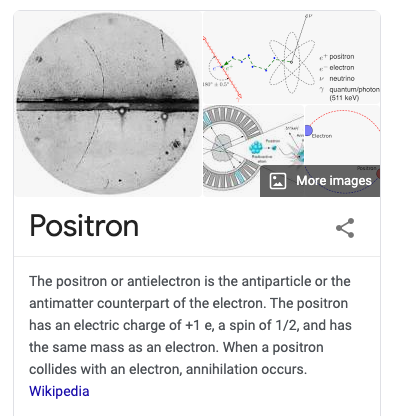
Positron: essentially a positively charged electron. (Though that's really simplifying things!)

If a positron is emitted or recieved, it is also a beta particle. 

ß+ particle: a high-energy positron (positively charged) emitted from a nuclear reaction.

So back to the definition of a beta particle.

A beta particle is a high-energy electron (ß-) or positron (ß+), generally seen during emissions from the atomic nucleus during radioactive decay.


Naturally, agreement to the definitions is not universal. Some sources will zealously differentiate between the ß- beta particle and the ß+ positron. I actually prefer this as a way of avoiding confusion!  Some will describe "beta decay," the  ß- emission, and "positron emission," the emitting of the ß+ , as distinctly different things.


Electromagnetic Radiation

Two other things closely related to nuclear reactions can be categorized as electromagnetic radiation. We should talk about that!

Most people interact with electromagnetic radiation… a lot. Constantly. In the form of…

Light
Heat
Cell phone transmission
WiFi
BlueTooth
Microwave ovens
X-ray
Radio (AM/FM/CB/Shortwave…)
and others…

Electromagnetic radiation is energy that radiates (or propagates) at the speed of light from a source.

Electromagnetic (EM) radiation is often modeled as a stream/wave of photons. Each type of EM radiation has a specific wavelength / frequency, but they all travel at c, the speed of light.

Photons are discrete energy packets (chunks) of electromagnetic energy which have properties of both particles and waves. Photons interact with matter in different ways, but frequently in a way that transfers energy from the photon to the matter. Different types of photons carry different amounts of energy.

Because photons can act as, at time, a particle, and, at other times, as a wave, they are sometimes thought of as wave-icles. Photons also are described as…

a beam of…
a ray of…
waves of…


Gamma Ray:

Many nuclear reactions emit electromagnetic energy from the nucleus in the form of gamma rays. A gamma ray is a penetrating form of EM radiation with extremely short wavelength and very high photon energy. 

x-ray:

Reactions involving electron capture will produce energy in the form of x-rays. X-rays are a high-energy form of EM radiation that penetrates and passes through most matter having short wavelengths and high photon energy.


How are x-rays, and gamma rays different, you ask? They have very similar properties, but gamma rays come from the nucleus of the atom and x-rays come from outside the nucleus. X-rays have lower energy than do gamma rays, as well.


…


Virtual Lab: Heat Exchange and Calculating Initial Temperature of Ice Sample

 General Chemistry Index

Where are we going with this? This page will assist in developing the ability to perform calculations involving heat flow, temperature changes, and phase changes by using known values of specific heat, phase change constants, or both.

Virtual Lab: Heat Exchange and Calculating Initial Temperature of Ice Sample


Background Information: Heat Exchange


The purpose of this activity is to provide hands-on experience using laboratory techniques to observe the transfer of energy from a hot substance to a cold substance. In this experiment, a sample of ice is introduced into a calorimeter and the final temperature and final mass is used to calculate the initial temperature of the sample.


Link to activity worksheet:  CLICK HERE

The video below has three parts:
  • Setup and Procedures
  • Result Collection
  • Calculation of Ti
The lab can be done virtually by watching the video, collecting data, and doing your own calculations.


Nuclear Chemistry Basic Concepts

General Chemistry Index

Where are we going with this? This page will assist in developing the ability to compare and contrast nuclear reactions with chemical reactions and to describe nuclear changes in matter, including fission, fusion, transmutations, and decays.


Nuclear Chemistry Basic Concepts

Okay… it is assumable that "nuclear chemistry" must be different from "chemistry" or else this page wouldn't be needed. 

Flashback… In a chemical reaction two or more elements combine to form a compound. A compound made up of the two or more elements that were originally present. In the end, you have the same numbers of the same types of elements. They are just combined into a new substance.

According to the Law of Conservation of Matter, matter can neither be created nor destroyed. You end up with exactly the same numbers and types of atoms from each of the reacting elements.

Okay, so… nuclear chemistry… "Nuclear" is an adjective. There's a root in there that's the same as "Nucleus." Hold that thought.

Chemical reactions occur when something happens in the electron shells. A couple of atoms will get together and have their electrons do stuff (lit. personification: that makes the atoms happy).

Electrons are located OUTSIDE the nucleus of the atom. So, changes in "normal" chemistry occur outside the nucleus.

In nuclear chemistry, the changes also occur WITHIN the nucleus. Something happens with the protons, neutrons, and electrons.

https://www.google.com/search?q=nuclear+chemistry


Nuclear Chemistry: The study of chemical reactions dealing with changes and transformations in the nuclei of atoms.


So, applying the Law of Conservation to nuclear chemistry… and over-simplifying… In a nuclear reaction, the total number of protons, neutrons, and electrons remains the same.

Caveat: it is possible for some of the mass to be converted to energy… that complicates things!

The reaction might combine all of the atomic particles, but in the end, the totals are all the same.

https://courses.lumenlearning.com/boundless-chemistry/chapter/nuclear-reactions/


______________

Looks like this is going to get complicated! We need to understand some words!

So that we can understand the different types of reactions!


About Me

My photo
Bill Snodgrass is a life-long teacher/mentor type who likes to see people develop into their best possible selves.