Search This Blog

Showing posts with label acceleration. Show all posts

Friday, May 4, 2018

Curving pitches, kicks, and shots…

So… In baseball and softball, many batters batters hate the curveball… Because it curves…
NOTE: The physics of this is true for ALL sports where a ball moves through the air… tennis, golf, ping pong, volleyball, soccer (bend it like Becker)…
Now, the curve in question is in addition to the fact that it is moving from the picture to the batter as a projectile which automatically means that it's up and down is changing at the same time it moves closer and closer to the batter.
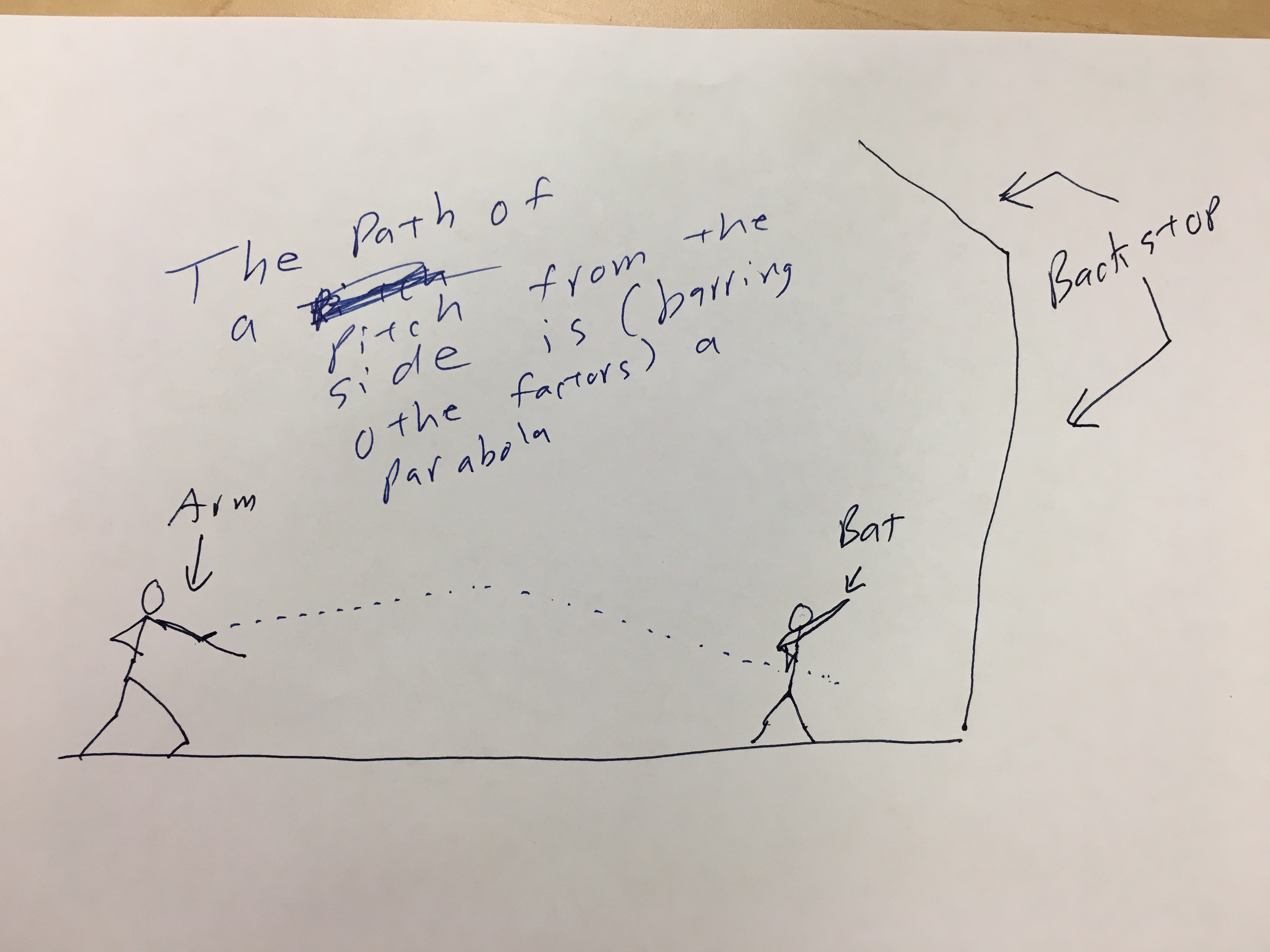
Imagine slow-pitch softball or a lobbed pitch… In the extreme, think about soft toss… The ball moves up and down as it approaches the strike zone.
So, every pitch regardless of type is, from the moment it is released affected by these three forces:
  1. Gravity pulls the ball down toward the center of the earth.
  2. There is a tiny, tiny buoyant force that is far far less than the force of gravity.
  3. There is air resistance (friction) that opposes the motion of they ball and which is always directly directly opposite the direction of the instantaneous velocity.
Now, let's talk about rotation! Because, except for a knuckle ball, pitches rotate…
Imagine a ball spinning on an axil, not moving. When the ball spins, the air around it is "drug" in the direction of the spin. Now, if you add in the movement of the ball, something happens!
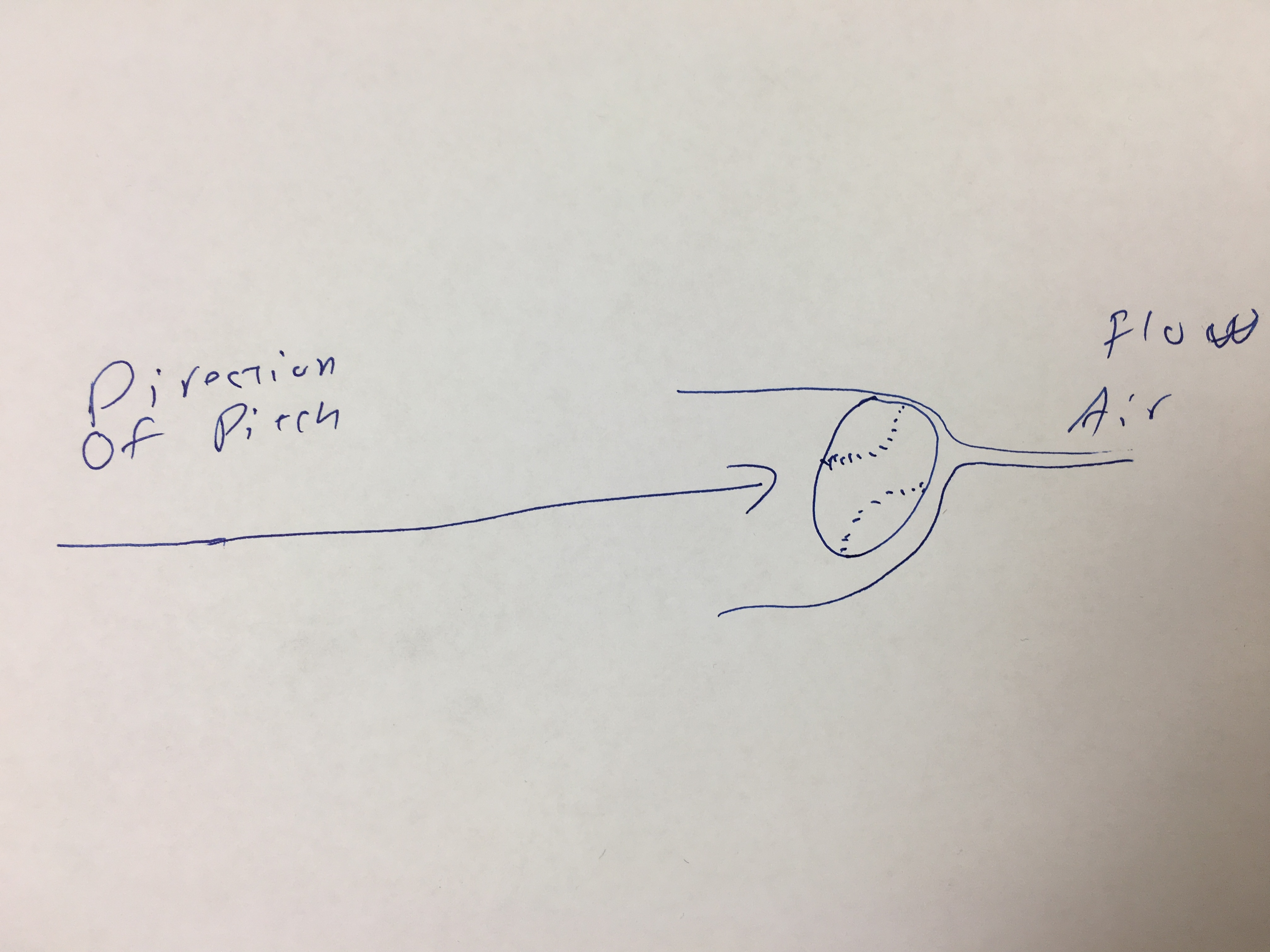
First if the ball is thrown and spin is ignored, you get an object moving through the air. The air flows around the ball equally. Nothing interesting there…
However, if you account for the spinning of the ball… and the air that is being drug around it by the spin, you start to see something.

When air moves faster, is gets stretched out. There are fewer molecules of air in the same space. From the gas laws, it is known that if you have fewer molecules in the same space, the pressure is lower (given constant temperature, which can be assumed over the diameter of a baseball or softball).
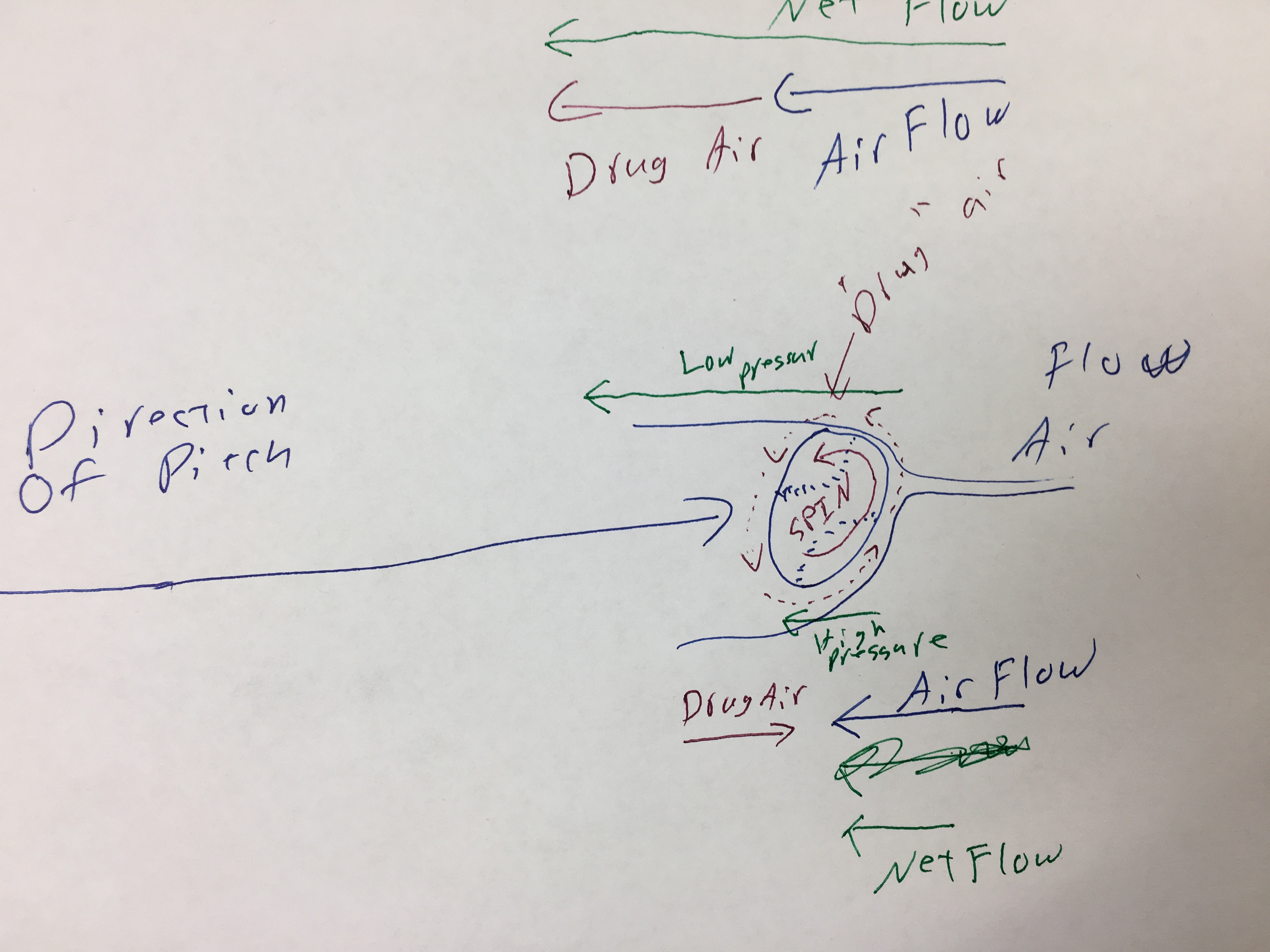
So, the spinning ball drags the air around it, AND those moving molecules of air interact with the moving air as the pitch moves through the air.  Where the drug air is going the same way as the air flow, the molecules move faster, but where the drug air is going in the opposite direction, the air flow slows down.
The result is that one side of the ball has high pressure and the other side has low pressure. The difference in pressure creates a force. The air pressure difference pushes the ball form the high pressure region to the low pressure region. 
That is to say there is a force acting in the direction of the low pressure. Given Newton's Second Law, it is known that F=ma, so where there is a net force, the ball must accelerate (change velocity) in the direction of the force.
Thus, the rate of acceleration can be found based on some function of the difference in pressure (F) divided by the mass of the ball:
a = ƒ(p1 and p2)/m
So, what can a pitcher do to make the ball curve? Well… you can't control the mass of the ball. You can control, however the spin.
Since the air moving around the ball due to it moving is the same on all sides, the spin accounts for the difference in pressure. Both p1 and p2 are affected by the spin
The net air flow is on one side pitch velocity + drug air.
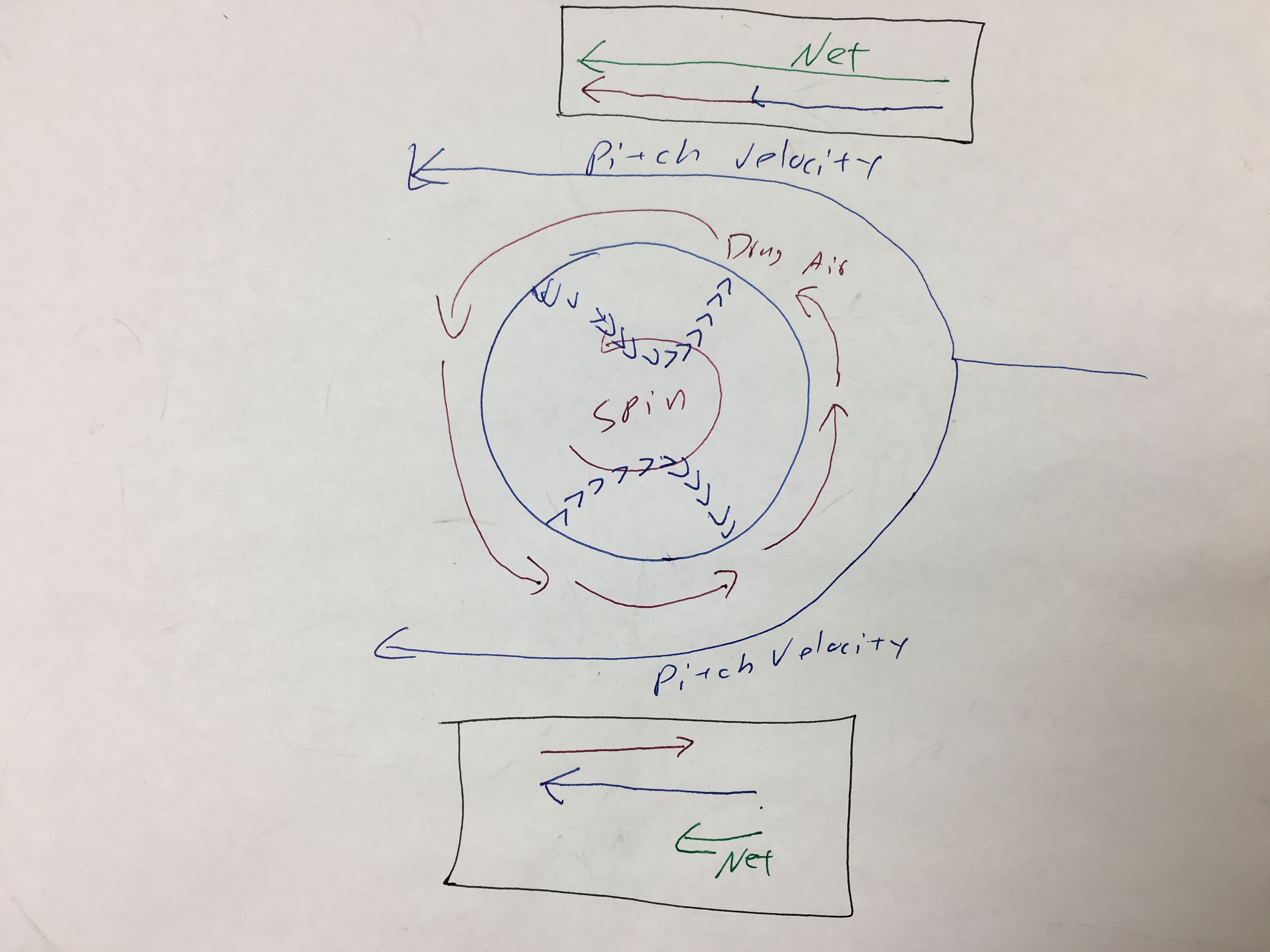
The net air flow on the other side is pitch velocity - drug air.
Thus, since the difference in pressure is a result of the DIFFERENCE in the net velocities of the air on opposite sides of the pitch path, the more spin, the bigger the difference in pressure.
AND, then, the bigger the difference in pressure (back to the math)…
a = ƒ(p1 and p2)/m
…the greater the rate of acceleration.
By controlling the spin allows a pitcher to control where the high and low pressure zones are. The ball will break into the low pressure zone.
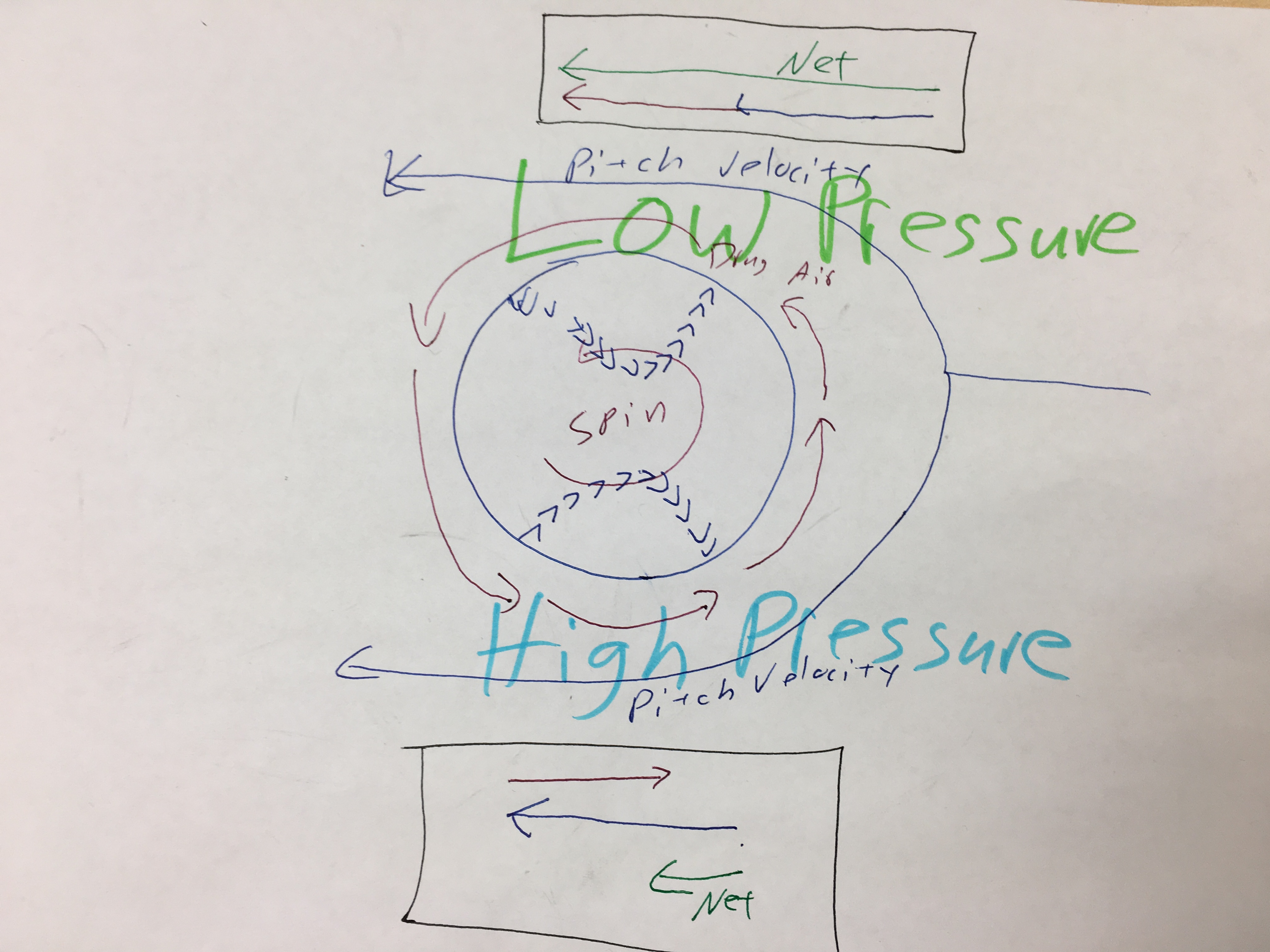
A pitch, then, with backspin, will dive. If the rotation is the other way (e.g. a good overhand throw), the ball will actually float some and the effect of gravity will be lessoned.
The LESS the axis of rotation aligns with the path of the ball, the GREATER the affect of the spin on the ball's path.
Conversely, if the axis of rotation aligns with the path of the ball's movement, then the affect of the spin is zero. Think of a spiral football pass. IF the pass/punt spirals properly, the affect of the spin is zero.
An overhand fastball rotates back toward the pitcher. Thus, there is low pressure on top of the ball.
An underhand fastball (or a topspin tennis shot) rotates forward toward the batter. Thus, there is low pressure on the bottom of the ball.
Cutters, sliders, etc have various spins that move the low pressure zone to different places on the ball.
CONCLUSION:
1.) Since the rate at which a ball's velocity changes can be found by
a = ƒ(p1 and p2)/m
and since the difference in pressures is caused by the spin, then changing the direction and rate of the spin will change the direction and rate of the acceleration (of the break).
2.) Increasing the rate of spin increases the difference in pressures. The greater the difference in pressure, the more the ball with break (accelerate).

Additional Notes:

1.) The diameter of the ball affects the velocity of the spinning surface. Thus, two balls of the same mass spinning at the same rate, but having different diameters will break differently. For example, a huge beachball with the same mass as a volleyball will curve more with the same spin.

Monday, April 16, 2018

Finding Time Using the Distance Equation

Any calculation of time (t) is relatively easy in the cases where either vi or a was zero. In the cases where neither are zero, the math results in a second degree polynomial equation such as:
0 = x2 + 3x - 12
Where this occurs in physics of motion is in the full distance equation:
df = di + (vi)(t) + (1/2)(a)(t2)
Although this does not exactly match the expected form for a quadratic equation, it can easily be rearranged as such:

df = di + (vi)(t) + (1/2)(a)(t2)
0 = di - df + (vi)(t) + (1/2)(a)(t2)
0 = (1/2)(a)(t2) + (vi)(t) + di - df

Keep in mind that di - df will yield a number when the values are plugged in and simplified.
To solve these problems, the steps are the same for any problem in science, BUT the algebra becomes harder.
After you have plugged in the numbers, combine like terms and simplify. Suppose the following:
df = 89
di = 50
vi = 4
a = 6
and you need to find t
df = di + (vi)(t) + (1/2)(a)(t2)
89 = 50 + (4)(t) + 1/2(6)(t2)
0 = -39 + 4t + 3t2
(Put it in normal quadratic form.)
0 = 3t2 + 4t - 39
Now you can either factor or use the quadratic formula to find the values for t:

0 = ( t  - 3 )( 3t + 13)
0 = t - 3    AND   0 = 3t + 13
3 = t        AND   -13/3 = t

Since time cannot be negative within the context of classical physics, only t = 3 is a valid answer.
Using the quadratic equation will yield the same results.

While it is far easier to find t when either a or vi is zero, the math to find t when that is not the case is not beyond the skills of a student taking an introductory physics class.
For another look at this process, check out this video:


​

Monday, March 27, 2017

Newton's Second Law

Newton's Second Law is one of the most famous of all things in the realm of physics. It is fundamental to so many aspects of physics, architecture, and engineering that it is hard to find anything that equally ranks in prominence.

Stated with words, Newton's Second Law says that if an object accelerates (if it changes magnitude or direction of its velocity), the force required is equal to the mass of the object times the rate of acceleration. 

So, to state that in less fancy terms… Say something is being pushed. If you push something, it's going to change velocity. (That could mean starting or stopping.) So, if you recall that changing velocity is the same as accelerating, then when you push something it accelerates. The harder you push, the faster it accelerates. The heavier it is, the slower it accelerates. 

Yet again, logic and common since prove true! If you just stop and think about it, you already understand this.

Just for fun, let's reprise…

If something has a lot of mass, it will change velocity less under a given force than if the same force is applied to something with less mass. The stronger the force, the faster an object will accelerate.

Naturally, since this is physics, there is a formula that models the relationship between mass, force, and acceleration. Where F is force, a is acceleration, and m is mass, then:

F = ma

This leads to a couple of derived formulas, just in case finding m or a is desired.

To find F:

F = ma

To find m:

m = F/a

To find a:

a = F/m


EXAMPLE 1:

Find the force needed to to cause a 5 kg object to accelerate at a rate of 20 (m/s)/s to the left.

F = find it
m = 5 kg
a = 20 (m/s)/s Left


F = ma
F = 5•20
F = 100 N Left

EXAMPLE 2:

If a 20 N force to the Right is applied to an object and causes it to accelerate at a rate of 4 (m/s)/s, what is the mass of the object?

F = 20 N Right
m = find it
a = 4 (m/s)/s

F = ma
20 = 4•m
20/4 = m
5 kg = m

OR

m = F/a
m = 20/4
m = 5 kg

EXAMPLE 3:

If a 15 N force to the Right is applied to a 3 kg object, what will the rate of acceleration be?

F = 15 N Right
m = 3 kg
a = find it

F = ma
15 = 3•a
15/3 = a
5 (m/s)/s = a

OR

a = F/m
a = 15/3
a = 5 (m/s)/s 


Summary

Using Newton's Second Law effectively allows demonstrating the relationship between mass, acceleration, and force. It follows logic and common sense completely, and the math requires only picking out the numbers, plugging them into the equation and using multiplication and division to solve for the missing variables.

Sunday, February 12, 2017

Acceleration, Velocity, Distance, and Time

The study of motion with relationship to time considers primarily how the position or velocity of an object changes with respect to time. In exploring these changes, definitions and formulas emerge:

displacement: the magnitude of the change in position of an object.
velocity: the rate at which the position of an object changes with respect to time.
acceleration: the rate at which the velocity of an object changes with respect to time.

df = di + vt
where df is final (or total) displacement, di is initial displacement, v is average velocity, and t is elapsed time.

vf = vi + at
where vf is final velocity, vi is initial velocity, a is acceleration, and t is elapsed time.

v(ave) = (vf+vi)/2
where v(ave) is average velocity, vf is final velocity, and vi is initial velocity.

Using the formulas above, it is possible to directly solve problems that ask about any combination of displacements, velocity and time or that ask about velocities, acceleration and time. However, to solve problems that ask about displacements, acceleration, and time, three steps were needed, if only the above formulas were used.

To solve the problems that that ask about displacements, acceleration, and time directly, a fourth formula is needed. This formula can be derived from the other three, but to get started, here it is:

df = di + vit + 1/2at2          (t2 means t•t or "t squared")

This equation is much more fun with di and vi are zero! But, to break it down as is first

df is the final, total displacement.

di is the initial displacement. How far from whatever point of reference is the object when the thing starts accelerating?

vit accounts for the motion of the object based on its starting velocity. It keeps covering distance at the initial rate.

The last term tells how much MORE distance is covered based on the acceleration. Since any di and vi are covered in the first term, the last term can be analyzed for the zero case, but first two examples.

EXAMPLE 1 (the zero case)

How far will a rocket travel while it accelerates from rest at a rate of 4 (m/s)/s for 5 seconds?

di = 0
vi = 0
vf = not given, not asked for
df = what you are looking for
a = 4
t = 5

df = di + vit + 1/2at2
df = 0 + 0 + 1/2 • 4 • 5•5

PEMDOS

df = 1/2 • 4 • 25
df = 2 • 25
df = 50


EXAMPLE 2
How far will a rocket travel while it accelerates from 20 m/s at a rate of 6 (m/s)/s for 3 seconds?

di = 0
vi = 20
vf = not given, not asked for
df = what you are looking for
a = 6
t = 3

df = di + vit + 1/2at2
df = 0 + 20•3 + 1/2•6 • 3•3

PEMDOS

df = 60 + 1/2 • 6 • 9
df = 60 + 3 • 9
df = 60 + 27
df = 87


CONCLUSION:

The above examples can be checked using the three-step method. The equation used above can be used to solve for any of the variables, but does require dealing with squares and square roots. However, if that level of math does not present a problem, 

df = di + vit + 1/2at2

becomes the only equation needed for all cases of motion related to displacement. Combined with

vf = vi + at

all of the motion problems can be solved.


_____________________________________

Example 3 (Find a when given distance and time.)

Working through the three-step method to find acceleration for the case of di and vi = 0 results in a quick and easy calculation method that requires

Step 1: Divide df by t
Step 2: Double it
Step 3: Divide by t again.

Using the new equation, this emerges like this:

df = 1/2 a t2
df = 1/2 a • t • t
2 • df = a • t • t

2df/t = a • t
(2df/t)/t = a

(Same as the 3 step method! Wooo!)

To more correctly write the above equation results in:

2•(df/t2) = a


And that is called physics!


_____________________________________
WHO LOVES SOME MATH?

Okay, don't answer that. 

It is not hard to come up with the df = di + vit + 1/2at2 formula. Starting with the basic, simple case formulas, combining them quickly results in

df = 1/2at2

How is that done? Easily! Begin with

df = vt 

where v is the average velocity.

Remember that 

vf = at 

where vf is the final velocity. In the case of vi = 0, the formula for average velocity easily reduces:

v(ave) = (vf + vi)/2
v(ave) = (vf + 0)/2
v(ave) = (vf)/2

Now, back to vf = at! Plug it in!

So…
v(ave) = (vf)/2 becomes
v(ave) = (at)/2

Now, back to df = vt! Plug in (at)/2 for v:

df = (at)/2 • t

Clean up time:

df =  a • 1/2 • t • t
df = 1/2 • a • t • t
df = 1/2at2

Bam! That just happened!

Wednesday, February 1, 2017

Displacement and Acceleration

If the relationship between displacement, acceleration, and elapsed time is extended to the most general case, the following equations need to be combined.

1.)
df = di + vt

where df is the final displacement from the fixed point, di is the initial displacement from the fixed point, v is rate of change in position, (average velocity), and t is elapsed time.

2.)
Vf = Vi + at

where Vf is final velocity, Vi is initial velocity, a is the rate of acceleration, and t is the elapsed time.

3.)

Vave = (Vf  + Vi) / 2

where Vf is final velocity, Vi is initial velocity, and Vave is the average velocity.

To begin, start with the general displacement equation:

df = di + vt

Understanding that v is average velocity, the equation becomes:


df = di + ((Vf  + Vi) / 2) • t

And since Vf can be found in relationship to acceleration, the following emerges:


df = di + (((Vi + at) + Vi) / 2) • t


Solving the problem in steps generally is more easily understood. To find displacement when acceleration is present, do the following.

Step 1.) Find the final velocity: Vf = Vi + at

Step 2.) Find the average velocity: Vave = (Vf  + Vi) / 2

Step 3.) Find the displacement: df = di + vt

EXAMPLE

A model car is 3 meters from the starting line on a model car race track and it is moving at 2 m/s. It accelerates at a rate of 5 (m/s)/s for 4 seconds. How far does it end up from the starting line?

Step 0.) Collect the data!

di = 3 m
vi = 2 m/s
a = 5 (m/s)/s
t = 4

Step 1.) Find final velocity.

Vf = vi + at
vf = 2 + 5•4
vf = 2 + 20
vf = 22

Step 2.) Find average velocity.

v(ave) = (vf + vi)/2
v(ave) = (22 + 2)/2
v(ave) = 24/2
v(ave) = 12 m/s

Step 3.) Find the total displacement.

df = di + vt

(remember v is average velocity and t is the same elapsed time as for the acceleration)

df = 3 + 12•4
df = 3 + 48
df = 51 meters 

So, the model car ends up 51 meters from the starting line.

Acceleration, Final Velocity, and Average Velocity

What is acceleration? Most people more or less know this. But, let's start with an example!

To begin, imagine sitting in a car at a red light. When the light turns green, the driver presses the gas pedal. WHICH is CALLED the accelerator because… Pressing the accelerator, the flow of fuel to the engine increases causing the RPMs of the engine to increase. 

The passengers of the car feel themselves pressed back into the seat as the car moves forward. The speedometer begins to show a change in speed! 

5 MPH
10 MPH
20 MPH
40 MPH

That image is more than is needed to understand the concept of acceleration!


Acceleration is the rate that velocity changes over some period of time.


The effect of acceleration is to change velocity. This can be explored mathematically quite easily.

EXAMPLE:
Suppose a car is rolling along a highway at 55 MPH and the speed limit changes to 65. How much did it accelerate (speed up)?

Inspection of the numbers answers that question. It speed up by 10 MPH.

So… using vf for final velocity, vi for initial velocity, and ∆d for how much velocity changed:

vf = 65 mph
vi = 55 mph
∆v = 10 mph


The equation is equally intuitive:

vf = vi + ∆v

Suppose we wanted to find vf?

Find vf where
vi = 55 mph
∆d = 10 mph

vf = vi + ∆v
vf = 55 mph + 10 mph
vf = 65 mph

(Of course, you could solve for any of the numbers!)


There is a strong similarity between changing velocity and changing position.


When an object changes position, the rate of that change is velocity. When an object changes velocity, the rate of that change is acceleration. It is a whole lot like what has been learned in previous articles about velocity and position.

To quickly review that…

To find how far an object moves—that is to say, to find the magnitude of an object's displacement—the rate of position change is multiplied by the amount of time that it changes. Or, as an equation,  
df = vt  

where d is change in position (displacement), v is rate of change in position, (average velocity), and t is elapsed time. 
In some cases, displacement is not measured from the point at which motion begins, but is measured from some other fixed point. In those cases, the total displacement becomes the sum of the initial displacement (initial position) and the distance moved. In such a case, 
df = di + vt 

where df is the final displacement from the fixed point, di is the initial displacement from the fixed point, v is rate of change in position, (average velocity), and t is elapsed time. (And where elapsed time the difference between final time and initial time.)


Finding Final Velocity

What is true for displacement closely parallels what is true for acceleration.

The change in velocity can be found by multiplying the rate that velocity changes (acceleration rate) by the amount of time that it changes (elapsed time). As an equation,

v = at

where
v is the change in velocity (sometimes written as ∆v),
a is the rate of acceleration, and
t is the elapsed time.

In many cases, an object is already in motion (has an initial velocity) when the acceleration begins. Logic and reason lead to the conclusion that the final velocity of an object is the initial velocity plus or minus the change in velocity. Since change in velocity is found (see above) easily, the equation for final velocity is

vf = vi + at

where vf is final velocity, vi is initial velocity, a is the rate of acceleration, and t is the elapsed time. (And where elapsed time the difference between final time and initial time.)

In many cases, however, Vi is 0 (zero).


Finding Average Velocity


To extend and begin to combine the above principles of motion, it is necessary to first consider how to find average velocity when given the rate of acceleration and time. Fortunately, this is relatively logical and easy to reason out. And the math on it is equally easy!

To apply logic, if something accelerates at a constant rate, it starts our at one velocity and moves faster and faster until it reaches a final velocity. Suppose it starts out a 0 m/s and ends up at 4 m/s. Through the course of its acceleration, it passes through all of the velocities between 0 and 4 m/s.

That might look like this:

0 sec, v = 0
2 sec, v = 1
4 sec, v = 2
6 sec, v = 3
8 sec, v = 4

The data above shows and elapsed time of 8 seconds, and in that time, the velocity of the object changed from 0 to 4 m/s. It might be tempting to just guess that, since the final velocity was 4 m/s, over the 8 seconds, the average velocity was 2 m/s. If that guess was made, the answer would be correct.

The list below gives Vf, Vi, and Vave:

 Vf= 0, Vi=6, Vave= 3

 Vf= 10, Vi=16,, Vave= 13

 Vf= 0, Vi=10, Vave= 5

 Vf= 100, Vi=160, Vave= 130

 Vf= 4, Vi=8, Vave= 6

Simply allowing logic and reason to stand alone would violate the need of science to describe everything with equations! So, there is an equation:

vave = (vf  + vi) / 2


So what if vi is zero? The math gets even easier! 


vave = (vf  + 0) / 2
vave = vf / 2


NOTES AND HINTS:
See also THIS.

The Equations:


df = (di + ∆d)
Use this if:
  • You need to find the final distance, total distance, or final position AND You know BOTH di and how much d changes (e.g. it moves 10 meters)

vf = vi + ∆v
Use this if:
  • You need to find the final velocity AND You know BOTH vi and how much v changes (e.g. speed increases by 10 m/s)


v(ave) = (vi + vf)/2
Use this if:
  • You need to find the average velocity 
  • You know BOTH vi and vf (you might have to calculate vf!)


vf = vi + (a)(t)    This will answer almost all “how fast” questions.
Use this if: 
  • 2 velocities are given 
  • You don’t have distance

df = di + (vi)(t) + (½)(a)(t2)   This will answer almost all “how far” questions.
Use this if:
  • Only 1 velocity is given 
  • You have a distance given (df is rarely 0, but sometimes it is the unknown)


The hints and helps:


It is vi if… 
“…traveling at a rate of…” “…moving at…”"…has a velocity of…"


If it is “at rest” then vi = 0 and di is probably 0

The words "begin" and "starts" generally go with the initial values.

If it is “moving at a constant” rate or if it “has a constant velocity” then a = 0


It is possible that something not given (but which is not the thing to be found) should have a value of 0 (zero).


Moving on to Displacement


The ability to find an average velocity allows more work with acceleration to be done. Since, if the average velocity is known, the displacement can be found. The work can be done in three steps. 
  • First, find the final velocity.
  • Next, find the average velocity.
  • Last, use the average velocity and the elapsed time to find the displacement.

However, doing the work in three steps is not necessary, because math.

The  best, most direct, preferred process for the calculation of final distance/displacement will be revealed HERE.


Yet, just for the sake of having completed the thoughts above, an example is provided. 

EXAMPLE:

A car with an initial velocity of 20 meters per second (m/s) accelerates at a uniform rate of 3 (m/s)/s for 10 seconds. How far does it travel while it is accelerating?

Step 1.) Find the final velocity.

vf = vi + at
vf = 20 + 3 • 10
vf = 20 + 30
vf = 50 mph

Step 2.) Find the average velocity.

v(ave) = (vf + vi)/2
v(ave = (50 + 20)/2
v(ave) = 70/2
v(ave) = 35 mph

Step 3.) Find the displacement.  NOTE: the elapsed time is the same for displacement and acceleration.


df = di + vt
df = 0 + 35 • 10
df = 350 meters (350 m)


By combining an understanding of average velocity with the ability to find displacement and to find final velocity, it becomes possible to calculate the displacement that occurs during a period of acceleration.  This 3-step method can be used when given acceleration and time and asked to find distance.


About Me

My photo
Bill Snodgrass is a life-long teacher/mentor type who likes to see people develop into their best possible selves.