Search This Blog

Showing posts with label mass. Show all posts

Friday, May 4, 2018

Curving pitches, kicks, and shots…

So… In baseball and softball, many batters batters hate the curveball… Because it curves…
NOTE: The physics of this is true for ALL sports where a ball moves through the air… tennis, golf, ping pong, volleyball, soccer (bend it like Becker)…
Now, the curve in question is in addition to the fact that it is moving from the picture to the batter as a projectile which automatically means that it's up and down is changing at the same time it moves closer and closer to the batter.
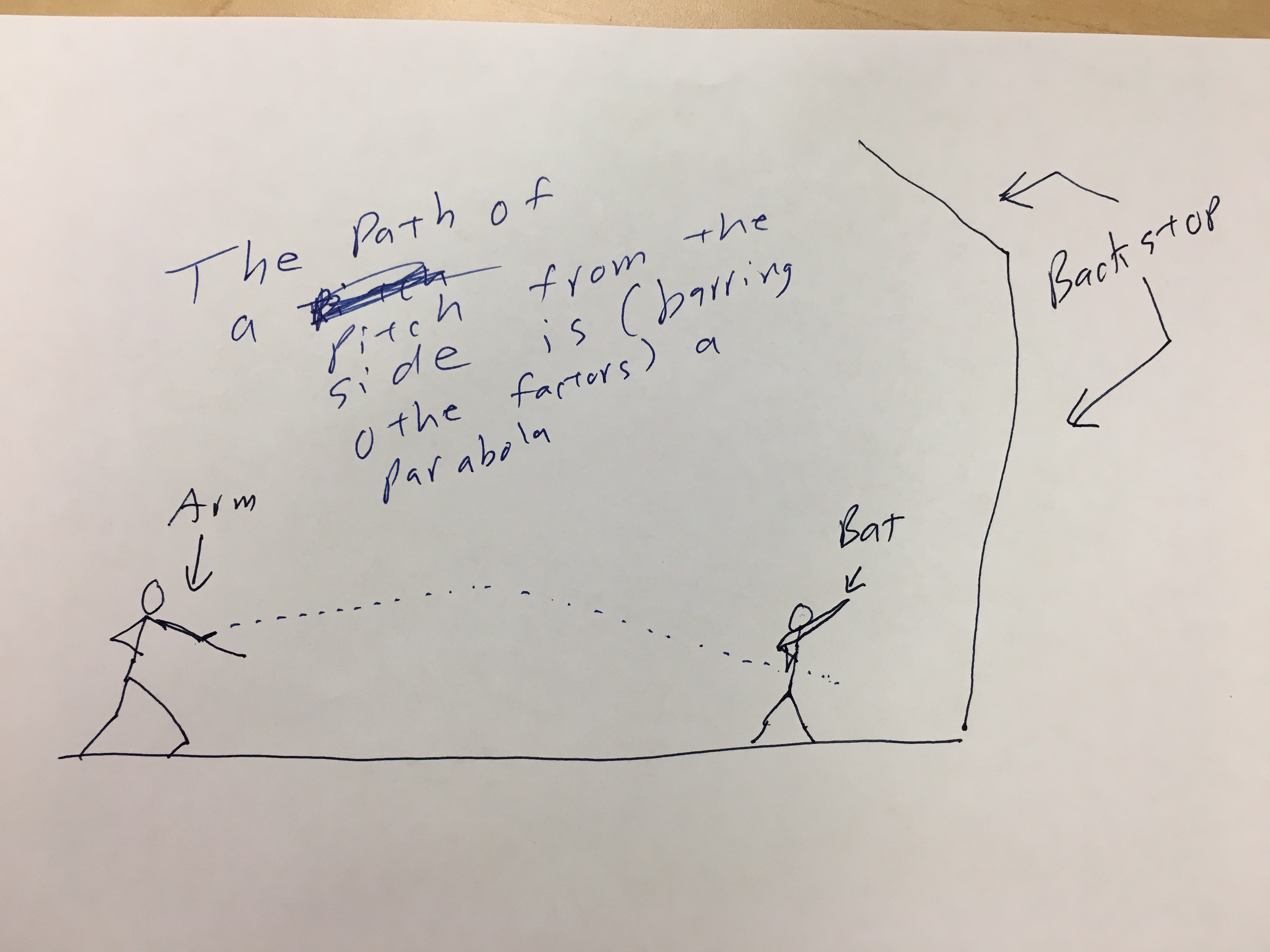
Imagine slow-pitch softball or a lobbed pitch… In the extreme, think about soft toss… The ball moves up and down as it approaches the strike zone.
So, every pitch regardless of type is, from the moment it is released affected by these three forces:
  1. Gravity pulls the ball down toward the center of the earth.
  2. There is a tiny, tiny buoyant force that is far far less than the force of gravity.
  3. There is air resistance (friction) that opposes the motion of they ball and which is always directly directly opposite the direction of the instantaneous velocity.
Now, let's talk about rotation! Because, except for a knuckle ball, pitches rotate…
Imagine a ball spinning on an axil, not moving. When the ball spins, the air around it is "drug" in the direction of the spin. Now, if you add in the movement of the ball, something happens!
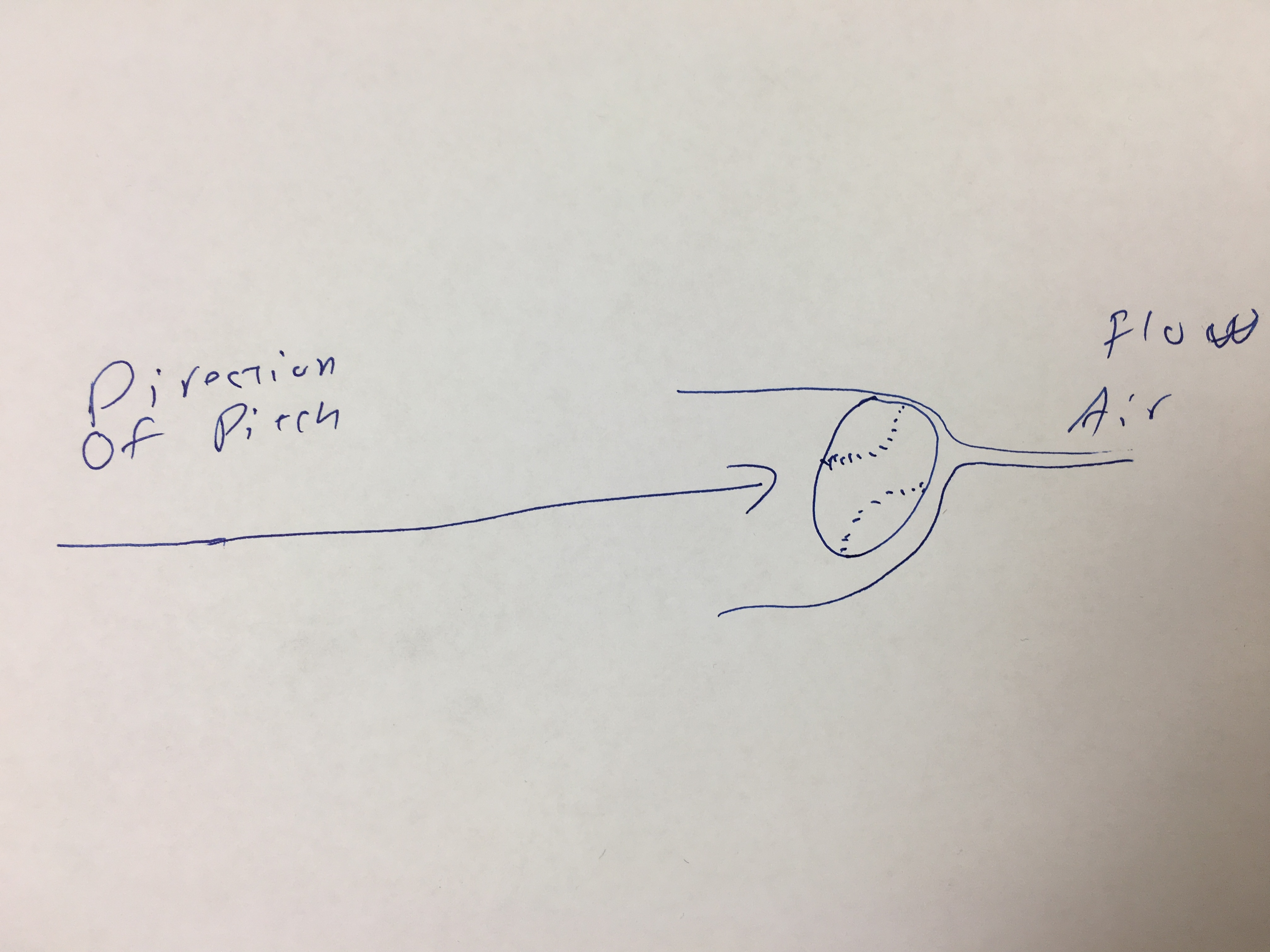
First if the ball is thrown and spin is ignored, you get an object moving through the air. The air flows around the ball equally. Nothing interesting there…
However, if you account for the spinning of the ball… and the air that is being drug around it by the spin, you start to see something.

When air moves faster, is gets stretched out. There are fewer molecules of air in the same space. From the gas laws, it is known that if you have fewer molecules in the same space, the pressure is lower (given constant temperature, which can be assumed over the diameter of a baseball or softball).
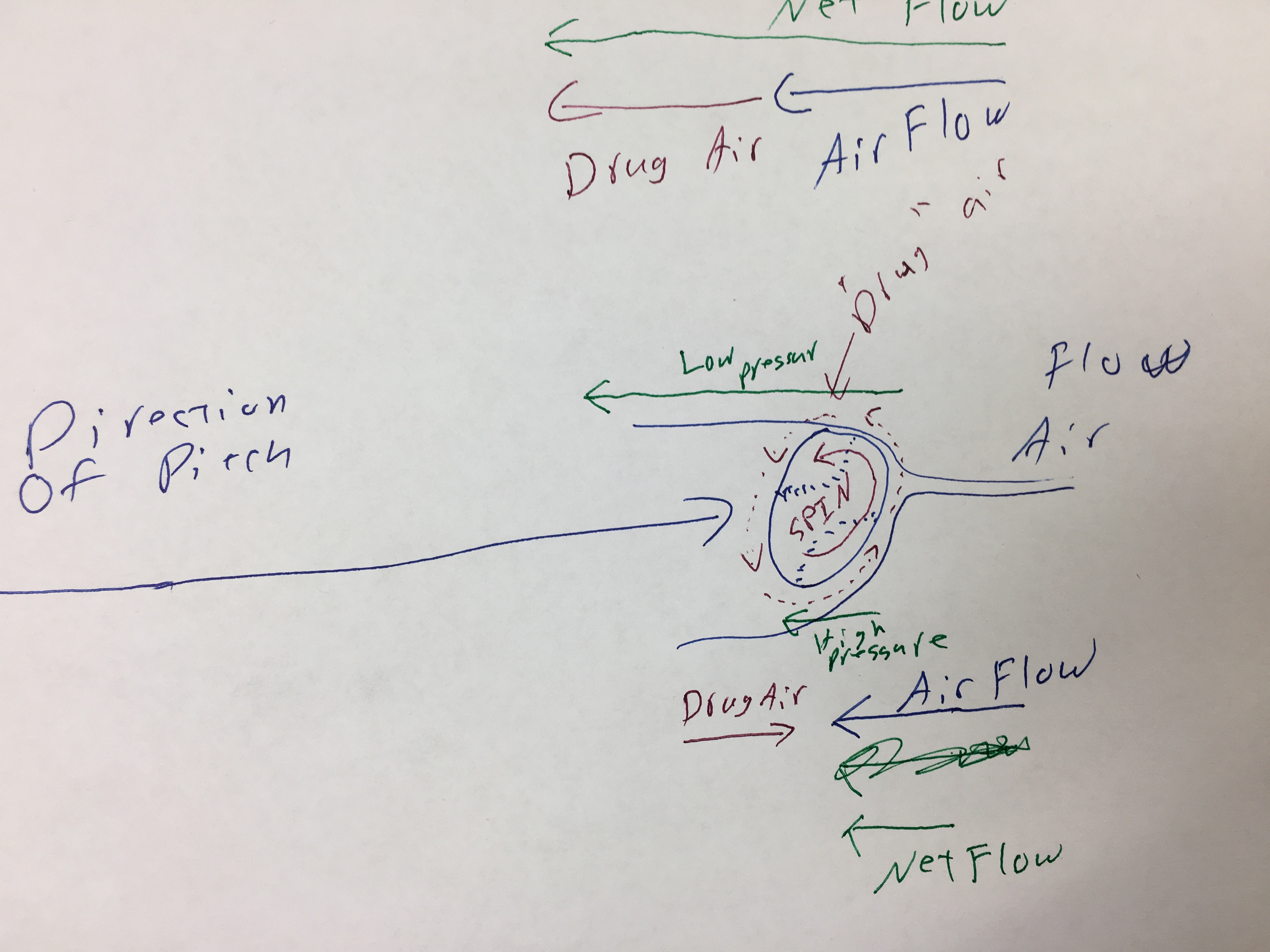
So, the spinning ball drags the air around it, AND those moving molecules of air interact with the moving air as the pitch moves through the air.  Where the drug air is going the same way as the air flow, the molecules move faster, but where the drug air is going in the opposite direction, the air flow slows down.
The result is that one side of the ball has high pressure and the other side has low pressure. The difference in pressure creates a force. The air pressure difference pushes the ball form the high pressure region to the low pressure region. 
That is to say there is a force acting in the direction of the low pressure. Given Newton's Second Law, it is known that F=ma, so where there is a net force, the ball must accelerate (change velocity) in the direction of the force.
Thus, the rate of acceleration can be found based on some function of the difference in pressure (F) divided by the mass of the ball:
a = ƒ(p1 and p2)/m
So, what can a pitcher do to make the ball curve? Well… you can't control the mass of the ball. You can control, however the spin.
Since the air moving around the ball due to it moving is the same on all sides, the spin accounts for the difference in pressure. Both p1 and p2 are affected by the spin
The net air flow is on one side pitch velocity + drug air.
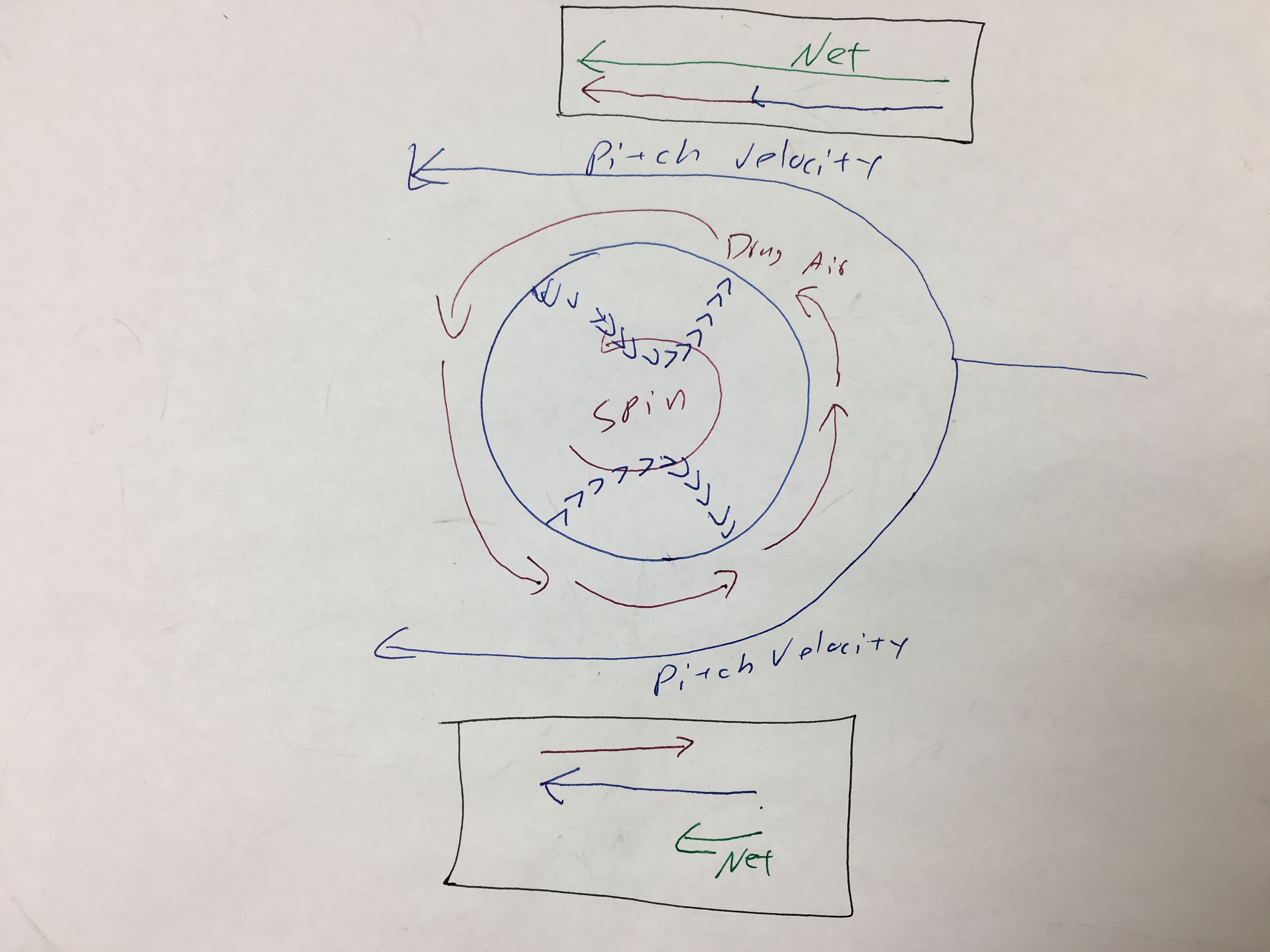
The net air flow on the other side is pitch velocity - drug air.
Thus, since the difference in pressure is a result of the DIFFERENCE in the net velocities of the air on opposite sides of the pitch path, the more spin, the bigger the difference in pressure.
AND, then, the bigger the difference in pressure (back to the math)…
a = ƒ(p1 and p2)/m
…the greater the rate of acceleration.
By controlling the spin allows a pitcher to control where the high and low pressure zones are. The ball will break into the low pressure zone.
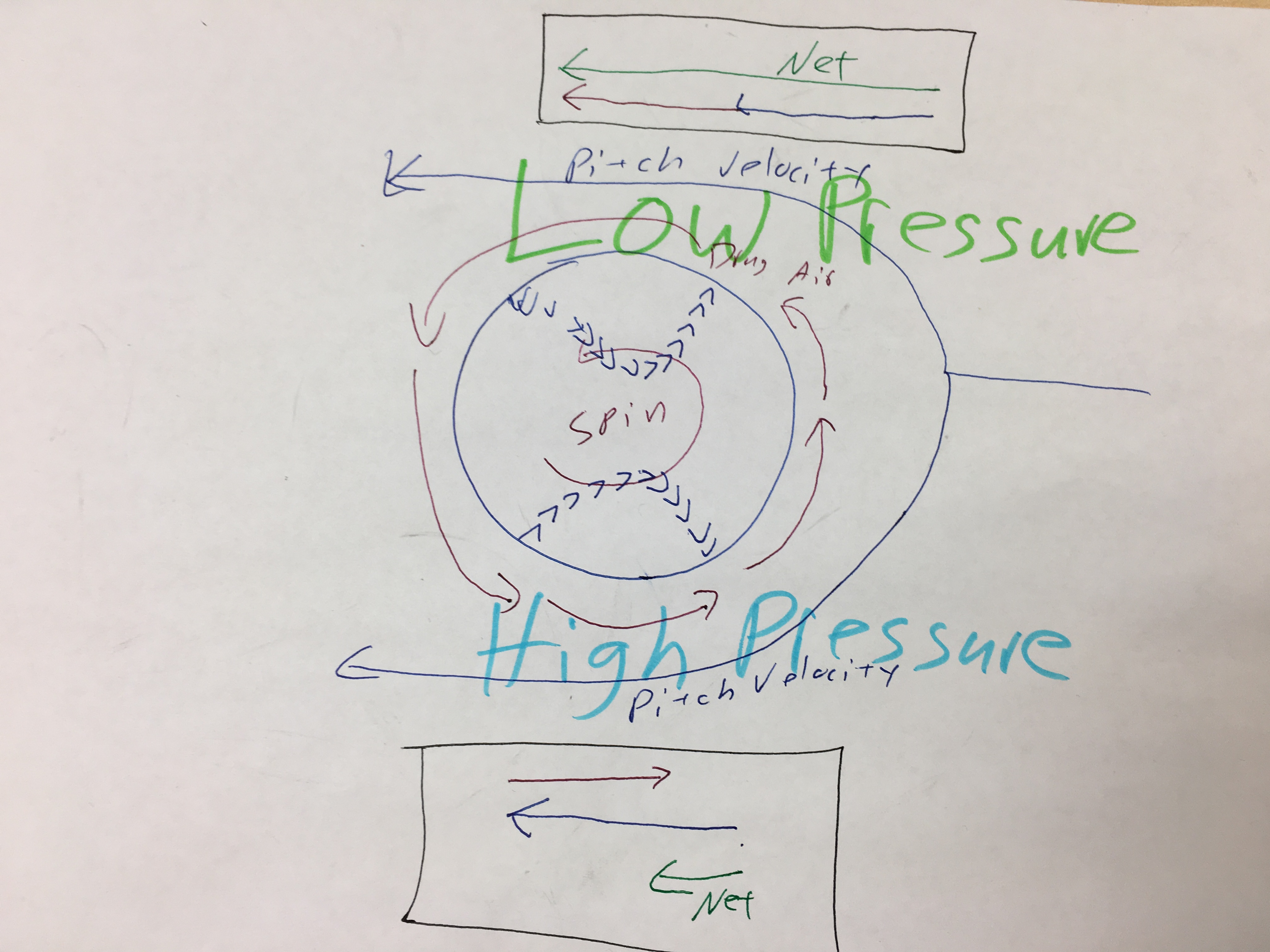
A pitch, then, with backspin, will dive. If the rotation is the other way (e.g. a good overhand throw), the ball will actually float some and the effect of gravity will be lessoned.
The LESS the axis of rotation aligns with the path of the ball, the GREATER the affect of the spin on the ball's path.
Conversely, if the axis of rotation aligns with the path of the ball's movement, then the affect of the spin is zero. Think of a spiral football pass. IF the pass/punt spirals properly, the affect of the spin is zero.
An overhand fastball rotates back toward the pitcher. Thus, there is low pressure on top of the ball.
An underhand fastball (or a topspin tennis shot) rotates forward toward the batter. Thus, there is low pressure on the bottom of the ball.
Cutters, sliders, etc have various spins that move the low pressure zone to different places on the ball.
CONCLUSION:
1.) Since the rate at which a ball's velocity changes can be found by
a = ƒ(p1 and p2)/m
and since the difference in pressures is caused by the spin, then changing the direction and rate of the spin will change the direction and rate of the acceleration (of the break).
2.) Increasing the rate of spin increases the difference in pressures. The greater the difference in pressure, the more the ball with break (accelerate).

Additional Notes:

1.) The diameter of the ball affects the velocity of the spinning surface. Thus, two balls of the same mass spinning at the same rate, but having different diameters will break differently. For example, a huge beachball with the same mass as a volleyball will curve more with the same spin.

Monday, July 31, 2017

Physical Quantities: Quantities and Units


Where are we going with this? This page will assist in understanding the relationship between units and the quantities they measure.


When looking at the world around, people pretty much automatically attend to physical quantities, pretty much without thinking about them. The youngest child intuitively can judge differences with some skill.

By the time the child reaches school age, the following conversation would seem drastically out of place:

Teacher: "Mary, how far can you run?"
Mary: "I can run six pounds! Very heavy!"

Almost all children would know that far and heavy describe different physical quantities.

As most readers of this would know, one of the jobs of science is to complicate things. No… not that… 
to clarify things by assigning specific words with specific meanings to specific ideas, objects and concepts in order to make discussion precise and accurate (which are both words surrounded by confusion, ironically).

Therefore, with regard to physical quantities, a certain set of words are used to describe specific things.

Included in those sets of words are two sides to every quantity. 

One side is the concept of what is being described. Mary, in the dialog above, gave an answer about one quantity with words used for a different. 

The other side of the concept is, for every quantity, specific ways that it is measured (which are called units). Pounds do not go with a "how far" question!

First what are the things being described?

Types of Physical Quantities

The following list is certainly not all-inclusive. It includes a few very common and familiar quantities that are measured.

Distance: Distance is a measure of… okay, distance is so common it actually has different meanings, so in science, there are different words that are used so in order to be more specific.

Distance (Most General): The measure of how far two points are from each other, as in, "The tip of the antenna was 12 meters from the the surface of the window."
Distance (A specific case) Think Distance Traveled: The length of a path that a moving body takes, as in, "The dog ran from tree to tree through the park until it was at the tree next to the one where it started, covering a distance of 250 yards." Compare with Displacement, next!
Displacement: The measure in a straight line between where a moving body begins and ends, as in, "The dog ran from tree to tree through the park until it was at the tree next to the one where it started, resulting in a displacement of only 4 yards."
Length, Width, Height: Pretty much what you expect, on this! The measure of how far specific points of an object are from other points on the object.
Other things that would be included in the distance concept are circumference, radius, perimeter, range, altitude, depth… You can probably think of others. But will you?

In general, distance is the measure of how far apart two things are.


Volume: (Not talking about sound, which borrowed from this concept for its own purposes!) This also is pretty much what you expect!

Volume is the space in three dimensions that an object or substance takes up (or holds). If a tank holds 25 gallons of gasoline, then the volume of the gasoline that filled the tank would be (duh) 25 gallons. A bottle of soda holds 20 ounces. A different bottle holds 2 liters.

Mass: Mass is a physical quantity that is the result of how many protons, electrons, and neutrons are all in a given space. It is actually not directly observable, though there are devices (scales and balances) that combine with gravity (or other acceleration) and other laws of physics so that it can be measured. Mass is a measure of the amount of matter an object contains.

If two things with the same volume have different masses, one would feel heavier than the other.

Good news: There are scales that measure mass, so you can just plop things down and get a number!

Weight: Weight is a measure of mass under a particular condition. Many people have heard things like, "Well, on the moon, I'd only weigh 12 pounds."

Weight is a basic concept that people are very familiar with. Weight is the degree of heaviness something has.

Time: This is something people very intuitively understand, but which is actually a very abstract concept. Stop reading and write down a definition of time. Not how time is measured! Try a definition of time that does not use seconds, minutes, hours, days, etc. and see what you come up with!

According to the Oxford dictionary, time is the indefinite continued progress of existence and events in the past, present, and future regarded as a whole. 

Time is a very basic concept in science, and fortunately, our intuitive understanding is enough for us to use it.

How do you measure these quantities?

The list below will connect the quantities above with the SOME OF THE units used to measure them. Common units in science are in bold and "normal" abbreviations for the common units are in parenthesis..

NOTE: Italics units are from the English system

Distance: inches, feet, yards, miles, meters (m), kilometers (km), centimeters (cm), light-years

Volume: gallon, ounce, cup, teaspoon, liters (l or lt), milliliters (ml)

Mass: slugs, grams (g or gr), kilograms (kg)

Time: hours (hr), minutes (min), seconds (s)


A few more…

Some units are derived or combined from the basic units but are so common they are worth noting here.

Force: Newtons (n or N), Pounds
Weight (which is a force) is also measured in pounds, newtons
Speed or Velocity: MPH, m/s, cm/s, km/hr
Speed or Velocity is a distance unit divided by a time unit.

Acceleration: (m/s)/s, MPH/s, (km/s)/s, cm/s2  m/s2
Acceleration is a velocity unit divided by a time unit.


At a glance…

System

Mass

Weight

Distance

Time

Acceleration
Due to
Gravity

English

Slug

Pound
lb

Feet

ft

Seconds

s

32 f/s/s

Metric

Kilogram
kg

Newton

N

Meters

m

Seconds

s

9.8 m/s/s


And also…

Temperature: Temperature is, within the kinetic theory of matter model, defined as the average kinetic energy of the molecules in a system or substance. How much thermal energy is present? How hot is it? The absence of thermal energy is described as being cold. Temperature is measured in degrees. In science, officially in Kelvin degrees (°K), but often in Celsius degrees (°C). 


SI Units

With so many units, things could get confusing. So… Some smart people made a decision that, a a general best-practice science would be built on seven base units. They also gave it a fancy name:

The International System of Units

Then… they decided they would abbreviate it… from French 

Système international (d'unités)

The seven base SI units and some corresponding constants allow meaningful and uniform dialog about all matters of science. 

https://en.wikipedia.org/wiki/International_System_of_Units


Monday, March 27, 2017

Newton's Second Law

Newton's Second Law is one of the most famous of all things in the realm of physics. It is fundamental to so many aspects of physics, architecture, and engineering that it is hard to find anything that equally ranks in prominence.

Stated with words, Newton's Second Law says that if an object accelerates (if it changes magnitude or direction of its velocity), the force required is equal to the mass of the object times the rate of acceleration. 

So, to state that in less fancy terms… Say something is being pushed. If you push something, it's going to change velocity. (That could mean starting or stopping.) So, if you recall that changing velocity is the same as accelerating, then when you push something it accelerates. The harder you push, the faster it accelerates. The heavier it is, the slower it accelerates. 

Yet again, logic and common since prove true! If you just stop and think about it, you already understand this.

Just for fun, let's reprise…

If something has a lot of mass, it will change velocity less under a given force than if the same force is applied to something with less mass. The stronger the force, the faster an object will accelerate.

Naturally, since this is physics, there is a formula that models the relationship between mass, force, and acceleration. Where F is force, a is acceleration, and m is mass, then:

F = ma

This leads to a couple of derived formulas, just in case finding m or a is desired.

To find F:

F = ma

To find m:

m = F/a

To find a:

a = F/m


EXAMPLE 1:

Find the force needed to to cause a 5 kg object to accelerate at a rate of 20 (m/s)/s to the left.

F = find it
m = 5 kg
a = 20 (m/s)/s Left


F = ma
F = 5•20
F = 100 N Left

EXAMPLE 2:

If a 20 N force to the Right is applied to an object and causes it to accelerate at a rate of 4 (m/s)/s, what is the mass of the object?

F = 20 N Right
m = find it
a = 4 (m/s)/s

F = ma
20 = 4•m
20/4 = m
5 kg = m

OR

m = F/a
m = 20/4
m = 5 kg

EXAMPLE 3:

If a 15 N force to the Right is applied to a 3 kg object, what will the rate of acceleration be?

F = 15 N Right
m = 3 kg
a = find it

F = ma
15 = 3•a
15/3 = a
5 (m/s)/s = a

OR

a = F/m
a = 15/3
a = 5 (m/s)/s 


Summary

Using Newton's Second Law effectively allows demonstrating the relationship between mass, acceleration, and force. It follows logic and common sense completely, and the math requires only picking out the numbers, plugging them into the equation and using multiplication and division to solve for the missing variables.

Wednesday, November 2, 2016

The Periodic Table

As an emersion into Reactions Between Substances, we explored the idea that compounds are formed by combining elements in certain, specific, fixed ratios. According to the Law of Definite Composition, every compound is made up of a fixed, specific ratio of the atoms that make it up. And because atoms of any element have the same atomic mass, compounds form in, not only fixed ratios of the number of atoms, but also in fixed ratios of masses.

By understanding how elements are arranged in the periodic table, we can begin to understand why they do this—why they always combine in fixed ratios. We can also begin to predict in what ratios they will combine.

The history of the Periodic Table is, perhaps, fascinating. Students of chemistry would serve themselves well by researching the topic and seeing how Mendeleev first constructed the table. Even with, in the 1860s, the incomplete knowledge of the elements, he was able to arrange them into something useful.

The first thing he did was put them in order by increasing mass from left to right and top to bottom. Thus, beginning at top left and moving across the rows, then down, the elements increase in atomic mass sequentially.

Secondly, he put into columns those elements that behaved similarly in reactions and that had other similar properties. Where there were missing elements in his time, he left spaces, and in time, those spaces were filled in with newly discovered elements.

In time, new discoveries were made and the Periodic Table was adapted to incorporate them. Much information was gained by the discovery of protons and eventually electrons.


The Modern Periodic Table

The modern Periodic Table arranges the elements in order by increasing numbers of protons.

The number of protons is called the Atomic Number. This is the order by which the modern periodic table is arranged.

The columns became organized to match the arrangement of electrons in the various orbitals. This is very important because an element's electron configuration determines how it will interact with other elements. 

Each column of similar elements is called a group and each element is in the group because it has a similar electron configuration.

Each row of the table is called a period. The periods correlate to the orbitals that are sequentially filled by electrons.


The Periods (Rows) and Groups (Columns)

For any element, all electrons must exist in a set, specific orbital—though exactly where in that orbital is a matter of probability, not certainty. Various orbitals have different energy levels and can hold only a certain number of electrons:


For any element, all electrons must exist in a set, specific orbital—though exactly where in that orbital is a matter of probability, not certainty. Various orbitals have different energy levels and can hold only a certain number of electrons:

Energy LevelNumber of OrbitalsMaximum Electrons
112
248
3918
41632


The elements of the Periodic Table are arranged into periods (rows) based on which orbitals exist in an atom of that element.The period number is equal to the number of orbitals that are present.

The elements of the Periodic Table are organized into groups (columns) based on how the electrons are filling the available orbitals.


The first period represents the filling of the first, lowest-energy-level orbital. Recalling that each orbital holds only two electrons, it follows that only two elements (H and He) can be in the first period (and located in the first row of the Periodic Table).

Periods 2 and 3 (rows 2 and 3) each add a set of orbitals in the second energy level. Thus, row two is made up of the elements has a filled the single orbital of the first period and is filling 4 more orbitals. The elements on row three have all of the electrons on the first orbital, all of the electrons on the first set of four orbitals from period 2, and is filling four more orbitals.

Period 4 begins with 18 electrons and adds a set of orbitals from the third energy level (18 more spaces.) It would be simply far to easy for the additional electrons to fill the 9 new orbitals! Instead, chemistry hocus pocus happens, and there are only openings for 8 electrons.

In the link above, you see the electron configuration for each element. The 18 electrons scooted down leaving the set of 8 electrons to interact with other elements. So, for example, iron (Fe, atomic number 26) has 2 electrons on the first orbital (Level 1), 8 electrons on the second set of orbitals (Level 2), then 14 electrons on the third set of orbitals (level 3), and only 2 electrons on the fourth set of orbitals. By the time you get to the end of the 4th row, krypton (Kr, atomic number 36) has electrons located in 4 sets of orbitals as follows: 2, 8, 18, 8.

If you are confused, that's not surprising.

A few summary thoughts:
  • Columns 3 through 12 are just weird.
  • Rows 6 and 7 are also weird.
  • The electrons in the "outer shell" establish how it is going to react with other elements.
  • Column 1 always has 1 electron in its "outer shell."
  • Column 2 always has 2 electron in its "outer shell."
  • Column 13 always has 3 electron in its "outer shell."
  • Column 14 always has 4 electron in its "outer shell."
  • Column 15 always has 5 electron in its "outer shell."
  • Column 16 always has 6 electron in its "outer shell."
  • Column 17 always has 7 electron in its "outer shell."
  • Column 18 always has 8 electron in its "outer shell."
A more appropriate name for the "outer shell" is to recognize that it is the group of electrons in the element's highest energy level. The electrons in an element's highest energy level are called valence electrons. Elements in any group (column on the periodic table) react similarly and have similar properties because they have the same number of valence electrons. 

Because of the valence electrons, atoms can be assigned relative valence charges. Thinking about elements based on these charges is useful for predicting how they will react.

This periodic table shows charge information (number in upper right corner):

The valence charge represents the tendency of the atom to either give up its electron in a reaction or take on the electrons from another atom. Atoms want to combine so that in a sense, between all the atoms involved, eight valence electrons are present. 

It is sort of like this…

Once upon a time, there was an unhappy sodium (Na) atom who had just one lonely valence electron (+1). It would be happier if someone would take it from it. It met up with chlorine, who was missing 1 electron (valence = -1). The chlorine needed that one, lonely valence electron to fill its own orbital to eight. So, it combined with sodium, holding on to sodium's electron, which gave the chlorine eight valence electrons. Sodium, having "given up" its lonely electron, was then "full" on the second set of orbitals. Both elements were happy, so long as they stuck together!

Sort of…

Another example with chlorine is when it combines with aluminum.

Because aluminum has a valence charge (or just valence) of +3 and chlorine has a valence of -1, they combine in a fixed, set ratio of 3:1. It takes 3 chlorines to combine with one aluminum to form aluminum chloride (AlCl3).

The vital things to understand about the periods and groups are:
  • The elements in each column (group) have something similar in their electron configuration.
  • The elements in each row (period) are filling a particular set of orbitals.
  • Based on how the electrons arrange, each element has a valence charge which is generally common for all elements in a group.
  • Columns 3 - 12 are weird.
  • Each element in a group will react with elements in other groups in a way to adjust the electron configuration so that a full set of valence electrons exists.

Atomic Mass

One more piece of information on the Periodic Table that is very important is the Atomic Mass. The Atomic Mass is the sum of the masses of all the protons and neutrons in the atom. (To find out how many neutrons are in an atom, subtract the Atomic Number (number of protons) from the Atomic Mass.)

The Atomic Mass is also the mass in grams of one mole of the element's atoms.


Summary Remarks
  • The Atomic Number is the number of protons. Elements are arranged on the Periodic Table according to Atomic Number. It is an integer, the count of the number of protons, and is usually located at the top of the element listing.
  • The elements of the Periodic Table are arranged into periods (rows) based on the the orbitals that exist in the atom.
  • The elements of the Periodic Table are organized into groups (columns) based on how the electrons are filling the available orbitals.
  • Each element in a group will react with elements in other groups in a way to adjust the electron configuration so that a full set of valence electrons exists.
  • The valence charge represents the tendency of the atom to either give up its electron in a reaction or take on the electrons from another atom. Atoms want to combine so that in a sense, between all the atoms involved, eight valence electrons are present. Some Periodic Tables include this, and is an integer with a + or - in front of it.
  • The Atomic Mass is the sum of the masses of all the protons and neutrons in an atom, and it is also mass in grams of one mole of the element's atoms. It is a decimal number, and usually located at the bottom of the element listing.

Atomic Theory Essentials


About Me

My photo
Bill Snodgrass is a life-long teacher/mentor type who likes to see people develop into their best possible selves.