Search This Blog

Monday, May 6, 2019

Nuclear Energy

In the 21st Century, the concept of nuclear energy is not strange to most people. Generally speaking, people know about nuclear bombs and nuclear power plants. Many people can explain that the sun (that stars) are giant nuclear plants that give off energy.

In the 1990s, the band, They Might Be Giants produced a song that stated:
The sun is mass of incandescent gas, a gigantic nuclear furnace
Where hydrogen is built into helium at a temperature of millions of degrees


-- They Might Be Giants - "Why Does the Sun Shine? (The Sun is a Mass of Incandescent Gas)"


So, how exactly does nuclear energy work? 

This goes back to the four basic forces that exist. Some people will recall they are:
gravitational
electromagnetic
strong (nuclear)
weak (nuclear)
Nuclear energy is associated with the last two. It takes a lot of energy to hold an atom together. That energy can be released when the atom is split.

Nuclear fission, the splitting of an atom's nucleus, releases a great deal of stored energy by… we'll get to that in a moment.

Another process related to the nucleus (hence the term nuclear) is when two or more nuclei are shoved together. This also results in the release of a great deal of energy!

Nuclear fusion, the joining of two or more atom's nuclei, releases energy by… stand by! Getting to that soon.

Both fission and fusion release energy. But how? And why so much?

Fission and fusion both involve altering the nuclei of atoms. Fission splits a nucleus and fission joins two or more. It is important to note that both fission and fusion result in atoms that have different atomic numbers (number of protons) than the original elements. For instance fusing hydrogen (atomic number 1) results in heliums (atomic number 2).

Something else happens when fission and fusion take place. Those of you who like to break the laws will really like this! (Note: breaking laws is agains the law and should not be done, ever. Unless you are fission or fusion.)

The law of conservation of matter is broken. The mass before and after nuclear reactions is different. The law of conservation of matter says that matter cannot be created or destroyed. Well…

There is also a law of conservation of energy that says that energy cannot be created or destroyed--that it only changes form. Well…

The processes of fission and fusion do not follow these laws. BUT!! The change in mass and the change in energy are related. In fact, they are exactly connected. Not only is the change in mass and energy connected, but they are connected by the most famous physics formula ever!

E = mc2

Yep!

This is what you've been waiting for ever since you first discovered Einstein's most famous formula!

So what does that mean?

It means that the conversion of matter to energy joins with the laws of conservation to result in a new, combined law:

The total of mater and energy is a constant never changing, but possibly interchanging.


Back to fusion and fission…

In nuclear reactions (both fission and fusion), energy is released (here are the conclusions) …by converting some amount of matter into energy. The amount of energy released is found using the equation

E = mc2

where E is the energy given off in joules, m is the mass in kilograms, and c is the speed of light (also the speed of an electromagnetic wave [energy]) which is a constant:

c = 299 792 458 m / s 
Now, nearly never is c written that way. The normal procedure is to write it in scientific notation as: 
c = 3 X 10⁸ m/s 
So, who doesn't like exponential notation? 

Working with the equation is not difficult. Find c2  then multiply by the mass. Done.


DIVERSION INTO MATH

So, a review of finding the square in exponential notation seems in order…

Let's find y where:

y = x2

and x = 200

y = x2
y = 2002
y = 40,000

Now, 200 = 2  X  102

So…
y = x2
y = 2002
y = (200)2
y = (2  X  102)2

Recall that to raise an exponent to the power of an exponent, you multiply exponents. thus…

y = (2  X  102)2
y = 4  X  104

It is fine to leave the equation above as is, but for the sake of proof, we can take it one more step:

y = 4  X  104
y = 40,000


BACK TO NUCLEAR ENERGY

Working with the equation

E = mc2

is not difficult. Find c2  then multiply by the mass. Done.

Thus,  given any mass in kilograms, multiply by c2 to find the amount of energy in joules that is given off. Finding c2 and working out examples is left as an exercise for the reader.


_______________________
REFERENCES:


Thursday, March 21, 2019

Math is Communication

In science and engineering, math is a vital part of communicating the ideas related to any observation or situation. Sloppy or incomplete expressions of math only tell part of the story.

To properly tell the math story, it is necessary to use the math to explain what's going on. What are the things in the problem? What are their values? How are they related?

There is a relatively systematic approach to doing this. 


Where the relationship can be expressed mathematically, there is a value to following a standard way of expressing that relationship.

A very flexible and universal attack process is to:


1. Identify what is being looked for.
2. Identify what is given.
3. Find a formula that relates what is given to what is asked for.
4. Plug in the values given.
5. Solve for the looked for value.


It is important to fully accept that the math is a story. Math is a way to communicate the relationship between different quantities and properties. Math is the whole movie.

Just jotting down some numbers and coming up with an answer is like the movie trailer. It doesn't tell the whole story.

It is noteworthy that telling the math story is very similar to solving a math problem. Telling the story is only different in that it begins with the relationship between the parts, whereas solving a problem begins with the question, then identifies the relationship between what is given and what is asked to be found.

Math is often the most efficient way to explain the relationship between things and to show, when they interact, what happens. Suppose that a situation was described as follows:

A 10 newton force acts on a  5 kg box unopposed. What is the rate of acceleration.

Without math, using only words (and in the style of epic fantasy) here's what we would have:

Long, long ago, when the foundations of the universe were being created, the Creator deemed that there would be a universal relationship between the force acting upon an object, its mass, and the rate at which the force would accelerate it. So it came to pass that the rate of acceleration would be proportional to the force acting upon the object and inversely proportional to the mass of the object.
Some time later it occurred that there was a 5 kg box. Upon this box a force was applied and the magnitude of that force was 10 newtons. The relationship of force and mass resulted in the box changing velocity, accelerating from rest at a rate of 2 meters/second every second.

Now, with math, the same story:
F = ma
10 N = 5 kg • a
10 N / 5 kg = a
2 m/s/s = a
The story is the same, but the telling is different. Math tells the story of science and engineering.


It is vital to note that each line of the solution is a sentence in the math story, and every sentence must have a verb. In the case of math, the verb is the equal sign. Therefore, every line of the solution needs to have BOTH sides of the equation AND the equal sign, or else the story is not being told well.

SUMMARY

The math story begins with the formula, the relationship between all of the variables involved., The next part of the story is the insertion of the specific values into the formula. The conclusion of the story is the algebraic / arithmetic solution and reduction.

Tell the whole story!

1. Identify what is being looked for.
2. Identify what is given.
3. Find a formula that relates what is given to what is asked for.
4. Plug in the values given.
5. Solve for the looked for value.

Monday, March 18, 2019

Grams to Grams Stoichometry

The gist of this concept is fairly simple to understand. But, there are a lot of details between the concept and answering the questions.

The question will take the form of something like…
You have this much of something. How much of something else do you need for a complete reaction without anything being left over.
Simple enough on face value. But, did you catch the part about there being a lot of steps?

Let's do it.


Step One: Start with a balanced equation.

The balanced chemical equation is like a recipe. It tells the ratio of ingredients in the compound. The principle works for all types of reactions, but a simple synthesis reaction makes the simplest example, so we'll look at that.

And, the mention of recipe evokes the idea of food, so let's start there.

(Credit to my colleague, M. Peterson, for this example.)

Let's make some s'mores. You know…

Now, just to be fair, there are two types of s'mores (just as some compounds form in different ratios): there is the single-chocolate layer s'more and the double-chocolate layer s'more.

So, let's look at the balanced recipe for those:

Cracker = C


Marshmallow = M


Ch = Chocolate squares.


With these basic components two different varieties of S'more can be created!

Single Chocolate S'more

M + 2C + 3Ch --> MC2Ch4


Double Chocolate S'more

M + 2C + 6Ch --> MC2(Ch3)2


The coefficients to the balanced recipe tells how much of each thing is needed in a ratio. For the Single Chocolate S'more, the ratio is:

1:2:3 -->1

1 marshmallow : 2 crackers : 3 squares of chocolate --> 1 s'more


The ratio works for individual items, dozens of items, scores of items, bazillions of items, or…

…or moles of items.

With chemistry, the concept of the mole prevails because of its connection to grams through the atomic mass of the elements. A mole of atoms weighs in grams the atomic mass. This is super, super convenient!

Understanding that the balanced chemical reaction gives us a set, fixed ratio of the atoms that must combine is the first, vital concept needed for the grams to grams stoichometry process.

So, let's make some water? And some hydrogen peroxide? Sure…

2H2 + O2 --> 2H2O   (water)
H2 + O2 --> H2O     (hydrogen peroxide)
The balanced reactions above give us the ratio recipe for the molecules in the reaction. Granted, it is a simple synthesis reaction, but, as stated before, the principle that applies here and the method is the same regardless of the complexity of the reaction.

Step 1 is to find the balanced reactions. Done.

Step 2: Extract the ratio recipe from the coefficients.

Easy…

For the first reaction, the ratio is 2:1 --> 2

For the second reaction, the ratio is 1:1 --> 1

What does that even mean?

This is actually pretty awesome in that chemistry is cool sort of way. (Just nod and follow along. Trust me, it's awesome!)

Like the s'mores, it is the ratio of "things" needed for a complete reaction without leftovers.

In s'mores, if you have only 2 crackers, you need only 1 marshmallow. Done. Period. Having more than one marshmallow means you'll have leftovers.

In many cases of introductory chemistry, you are looking for complete reactions without leftovers.

So, for the H2O reaction (water), starting with 2 somethings of H2 requires 1 something of O2. The something can be molecules, dozens of molecules, thousands of molecules, or bazillions of molecules. However, counting molecules requires very, very, very small fingers #sarcasm! Counting them a bazillion times is a bazillion times harder!

This is where the mole concept comes to the rescue! The relationship between moles, atomic mass, and grams saves us.

Time to chant (seriously):
Moles to grams you multiply!
Grams to moles divide!
Repeat 10 X
So, if you know the number of moles, multiply by the atomic mass OF THE MOLECULE to find out how many grams you have.

If you know how many grams you have, divide by the atomic mass OF THE MOLECULE to find out how many moles you have.

Now, that we have that figured out, we are ready to go to the next step.

Step 3: Figure out how many moles of the given thing you have.

This is why we chanted.

Say you have 37 grams of O2 and you are doing the water reaction. How many grams of H2 do you need (to react completely without left over).


Okay, start with the balance reaction (step 1)

2H2 + O2 --> 2H2O

If you have 37 grams of Ohow many moles is that?  Okay, back up…

Step 3a: Find the MOLECULAR MASS for the reaction.  Let's put those numbers below the molecules in the reaction.

This is the mass of the molecules Not the mass of the reactants or products. 

2H2 + O2 --> 2H2O
  2 g          32 g              18 g 
A more complete look at the masses…

                    Atom Mass                                 1 g         16 g          2g 16g
                    Balanced Equation                    2H2 + O2 --> 2H2O
                    Molecule Mass                             2 g        32 g            18 g
                    Total Reactant/Product Mass       4 g         32 g            36 g  


Step 3b: Find the moles of what's given.  Chant!

Divide what you have by the mass of one molecule:

37 g / 32 g/mole  =  1.156 moles   (If the units confuse you, just chant again.)


Step 4: Use what you have (Step 3b) and the recipe ratio (Step 2) and find out what you need for the other thing.

That sounds more confusing than it is.

The recipe calls for:

2 : 1 --> 2

We have more than the 1 in the ratio, so we need to figure out what all of the numbers are. Easy.

Multiply the ratio (which is 2 : 1 --> 2)
by what you have (which is 1.156 moles)
divided by what you need (which is 1 mole)

So…

1.156/1 • (2 : 1 --> 2
2.312 : 1.156 --> 2.312
Now what?

That multiplication tells us how much of the other thing we need. In the case above, since we have 1.156 moles of O2, we need 2.312 moles of H2.

Step 5: Convert the moles needed of the other thing to grams.

This is why we chanted.

How much did one mole of H2 weigh? It's up there somewhere!

So, multiply!
2.312 moles • 2 g/mole = 4.624 grams.

Step 6: Bask in satisfaction that you are now done.

That's it. That's the answer. If you have 37 grams of O2 you need 4.624 grams of H2


__________________________________________

Let's do the peroxide without all of the discussion.

Starting with .75 grams of H2, how much O2 is needed to completely react without excess?

Step 1: Balance the equation:

H2 + O2 --> H2O

Step 2: Extract the recipe ratio:

1: 1 --> 1

Step 3: How many moles do you have to begin with?

H2 + O2 --> H2O
2 g          32 g             34 g

Grams to moles divide…

.75 g / 2 g/mole = .375 moles of H2

Step 4: Use the ratio to find moles of "other" thing.

.375/1 • ( 1: 1 --> 1 ) 
.375 : .375 --> .375

Step 5: Convert moles needed of the "other" thing to grams.

So, multiply!
.375 moles • 32 g/mole = 12 grams.


DONE AGAIN! 

__________________________________________

Summary:

The process is long, the concept is sorta complex, but it's really not all that hard. Just more tedious than anything.

Here are the steps:

Step 1: Balance the equation:

Step 2: Extract the recipe ratio:

Step 3: How many moles do you have to begin with?

Step 4: Use the ratio to find moles of "other" thing.

Step 5: Convert moles needed of the "other" thing to grams.

(Chanting is optional.)

Step 6: Bask in satisfaction.

Monday, November 12, 2018

Chemical Notation with Polyatomic Ions

General Chemistry Index

Where are we going with this? This page will give the ability to demonstrate an understanding of the law of conservation of mass through the use of particle diagrams and mathematical models.


When working with chemical notation, it has been established that the subscripts (or numbers FOLLOWING the elements) represent the number of those elements present. The coefficient tells how many of the molecule is present.

Thus,

3 H20 or 3 H2O or even 3H20

means 3 molecules of water in which are 2 atoms of hydrogen and 1 atom of oxygen.

There is another variation of this notation that is applied in certain cases with some compounds. Because of how the compounds form, there is sometimes a value in keeping some of the elements as a unit and subscripting the whole unit to show how many of that unit are present.

Look at the reaction below:

CaC2   +   2 H2O   --->   Ca(OH)2   +   C2H2

Notice on the product side, the OH is inside parenthesis. This represents that that is a unit of molecules that are being kept together based on how the compound is formed. The subscript indicates that there are two of these units present.

Examples:

3 Ca(OH)2 has in it, 3 Ca, 6 O, and 6 H. (The subscripted 2 applies to both atoms inside the parenthesis, and the coefficient of 3 applies to the whole molecule.)

Ca3(PO4)2 has in it, 3 Ca, 2 P, and 8 O. (The subscripted 2 applies to the PO4, so there are 2 P and 8 0)

2 Cu(NO3)has—to begin with, there are 2 molecules of Cu(NO3)2 as indicated by the coefficient.
  • EACH molecule has 1 Cu and 2 (NO3). Since there are 2 (NO3) (The subscript 2 applies to everything inside the parenthesis.), that means there are 2 N and 6 O in each Cu(NO3)molecule.
  • Since there are 2 molecules of Cu(NO3)2, there are in TOTAL:

    • Cu
    • N
    • 12 O

Summary:
  • Coefficients, the numbers in front, apply to the whole molecule and tell how many molecules or "sets" of molecules are present.
  • Subscripts (or number FOLLOWING the atom symbols) tell how many of that atom are in the molecule.
  • If a group of atoms are inside parenthesis:

    • They are to be kept together as a unit.
    • Any subscripts to the closing parenthesis means that there are that many units of the atoms inside the parenthesis are present.

Wednesday, September 26, 2018

Meet The ∆ — The Scientific Symbol For Change


Many times in science (and engineering), it is necessary to measure changes in things. There are many examples of this ranging from objects moving or the pressure of gases going from low to high.

The normal way of discussing these changes is to consider initial and final instances. Consider this example:

A runner begins moving at a distance of 20 meters from the picnic table. A moment later the runner is 50 meters from the picnic table. This means there was a change in distance from the picnic table of 30 meters.
In this case:
 The initial distance (from the picnic table) is 20 meters
The final distance from the picnic table is 50 meters
The change in distance is 30 meters.
Whereas in science and engineering, using a few numbers and letters as possible is the norm, and whereas different measures have "normal" symbols, the above way of describing the situation is never used in the actual solution of a problem.

The normal symbol for distance is d (but sometimes s for reasons I cannot remember), so it would be expected to use the d for the various distances. But, how can you tell WHICH of the distances being referenced? There must be some other means.

There is.

There are two common ways to distinguish between various distances (or anything else) in the same discussion (a lab writeup, a word problem, etc.). Both ways rely on putting a subscript after the variable symbol.

That will look like this:
VariableSymbolSubscript
So if there are more than once distance, one way is to use numbers for the different distances. Distance 1… Distance 2… Distance 3… That makes sense.

Example time:

A park has three water fountains. One is 20 meters from the pavilion. Another is 150 meters from the pavilion, The last one is 285 meters from the pavilion. Therefore…
d1 = 20 m 
d2 = 150 m
d3 = 285 m 
Another way to distinguish between different measures of the same quantity is to look at the "before and after" information. In such a case, the idea if "initial" and "final" are represented by the subscripts of i and f.

The usual symbol for temperature is T…

Example time:

A ball is kept in a refrigerator where the temperature is 10 C. It is moved out into the room where the temperature is 23 C.
Therefore…
Ti = 10 C
Tf = 23 C 
It is not unheard of to use 1 and 2 as the subscripts, even when it is clearly a before and after situation. Thus, the above information could be written as:
T= 10 C
T2 = 23 C 

INTRODUCING THE ∆


In many, many cases, the most interesting part of a situation is how the variable changes. In science and engineering, the change in something is represented by the  symbol before the normal quantity symbol. Therefore, given the typical symbols for distance and temperature:

The amount that distance changed would be written as ∆d
and
the amount that temperature changed would be written as ∆T.  

The concept of change is not limited to distance or temperature. Any measured quantity works. If something changes value, the ∆ can be used to represent the change.

Some "Change" Words

In stories or word problems, some words strongly represent a change in the measure. When encountered, these words will correspond to the ∆. This is NOT EVERY way to indicate use of the ∆, but usually, when you see these words, it will be not the initial or final value, but the ∆ value:
increased by
decreased by
changed by
moved
farther
closer
more
an additional
added (e.g. he added 5 more…)

Calculating Change

Finding the change in something is really easy. How much did you start with? How much did you end up with? What's the difference.

If you had 8 apples to start with and ended up with 12, the number of apples you had changed by 4.

It works the same way with distance, pressure, velocity, time, temperature, volume… it works the same with any measured quantity.

As a formula, if you are looking at distance, it looks like this.

∆d = df - di

NOTE: if you are using 1s and 2s as the subscripts, you need to make sure you know which was the final and which were the initial values.

SUMMARY

1. When more than one measure of the same quantity is required, the different measures are indicated by subscripts.

2. Subscripts can be i and f for initial and final, or can be numbers representing different measures.

3. The change in the measured thing is represented by the ∆ followed by the normal symbol.

Friday, May 4, 2018

Curving pitches, kicks, and shots…

So… In baseball and softball, many batters batters hate the curveball… Because it curves…
NOTE: The physics of this is true for ALL sports where a ball moves through the air… tennis, golf, ping pong, volleyball, soccer (bend it like Becker)…
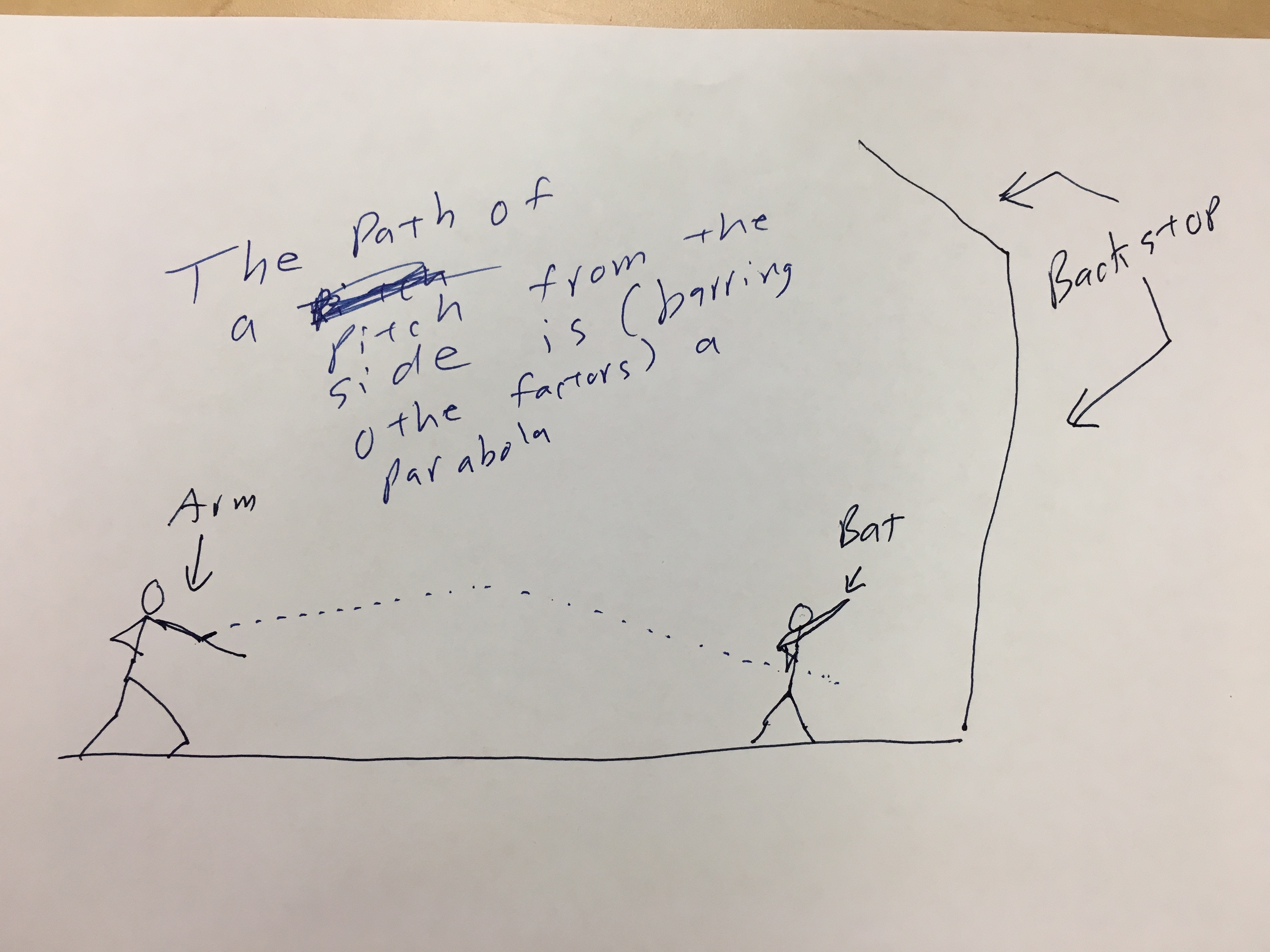
Now, the curve in question is in addition to the fact that it is moving from the picture to the batter as a projectile which automatically means that it's up and down is changing at the same time it moves closer and closer to the batter.
Imagine slow-pitch softball or a lobbed pitch… In the extreme, think about soft toss… The ball moves up and down as it approaches the strike zone.
So, every pitch regardless of type is, from the moment it is released affected by these three forces:
  1. Gravity pulls the ball down toward the center of the earth.
  2. There is a tiny, tiny buoyant force that is far far less than the force of gravity.
  3. There is air resistance (friction) that opposes the motion of they ball and which is always directly directly opposite the direction of the instantaneous velocity.
Now, let's talk about rotation! Because, except for a knuckle ball, pitches rotate…
Imagine a ball spinning on an axil, not moving. When the ball spins, the air around it is "drug" in the direction of the spin. Now, if you add in the movement of the ball, something happens!
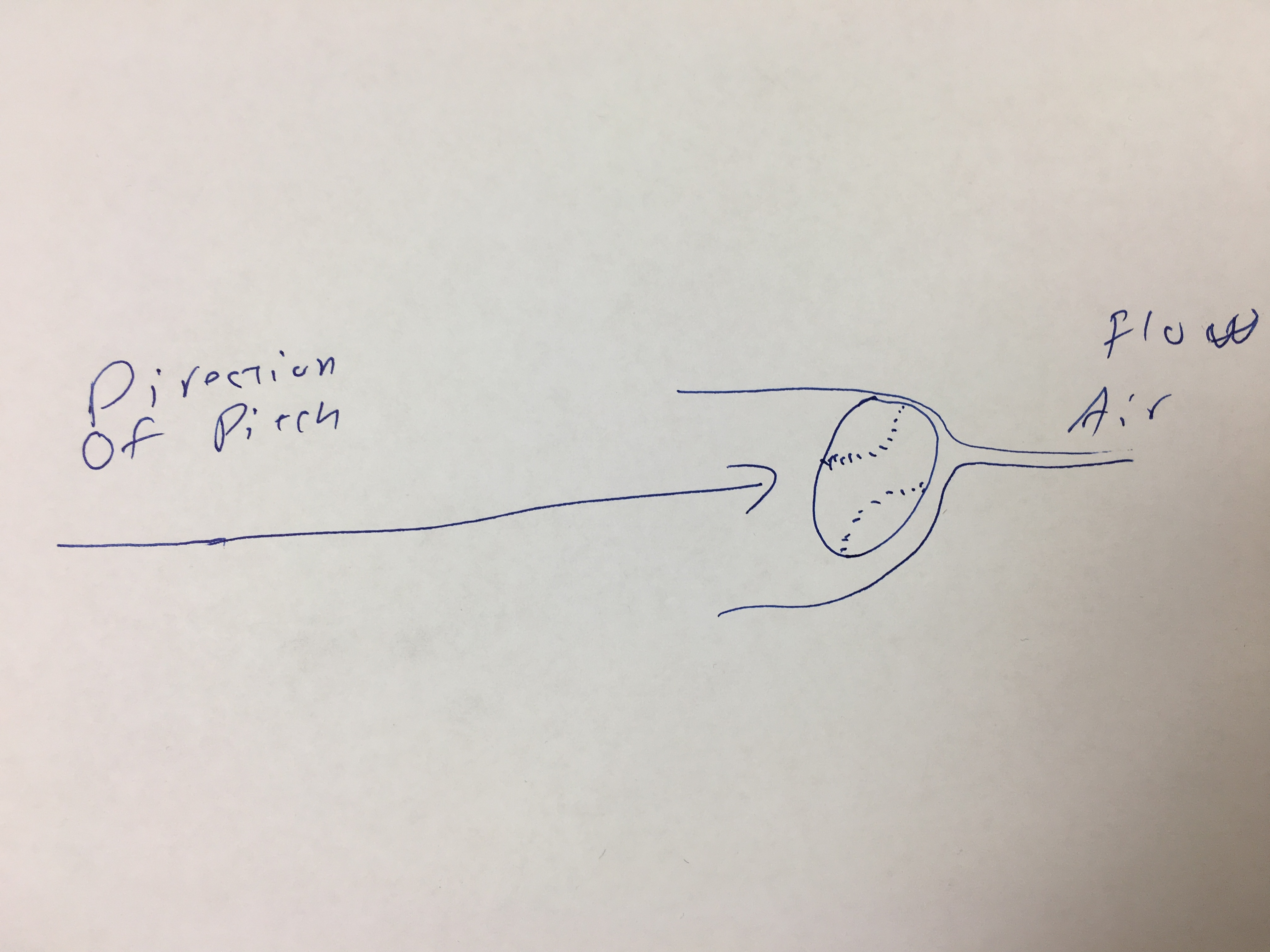
First if the ball is thrown and spin is ignored, you get an object moving through the air. The air flows around the ball equally. Nothing interesting there…
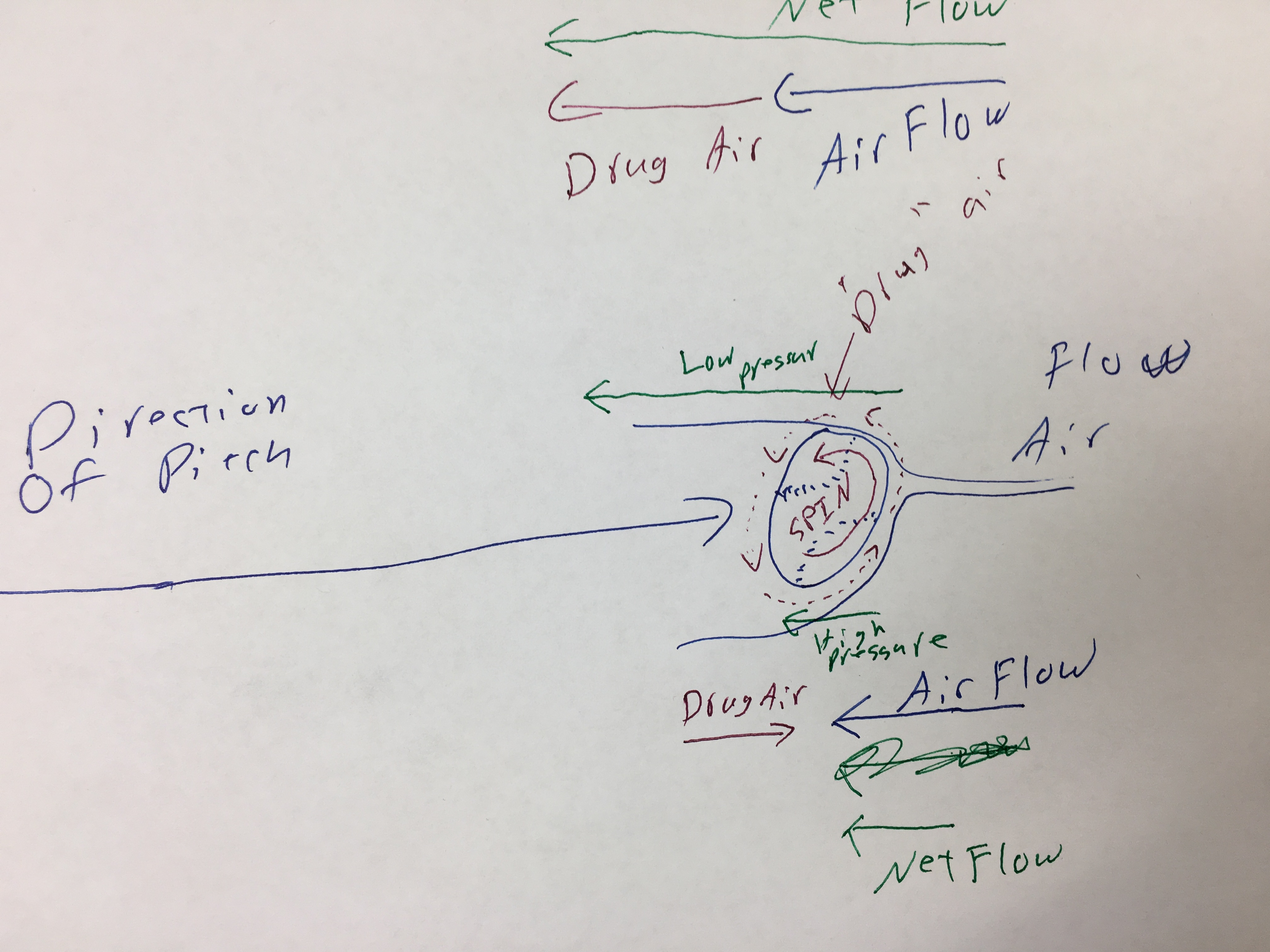
However, if you account for the spinning of the ball… and the air that is being drug around it by the spin, you start to see something.

When air moves faster, is gets stretched out. There are fewer molecules of air in the same space. From the gas laws, it is known that if you have fewer molecules in the same space, the pressure is lower (given constant temperature, which can be assumed over the diameter of a baseball or softball).
So, the spinning ball drags the air around it, AND those moving molecules of air interact with the moving air as the pitch moves through the air.  Where the drug air is going the same way as the air flow, the molecules move faster, but where the drug air is going in the opposite direction, the air flow slows down.
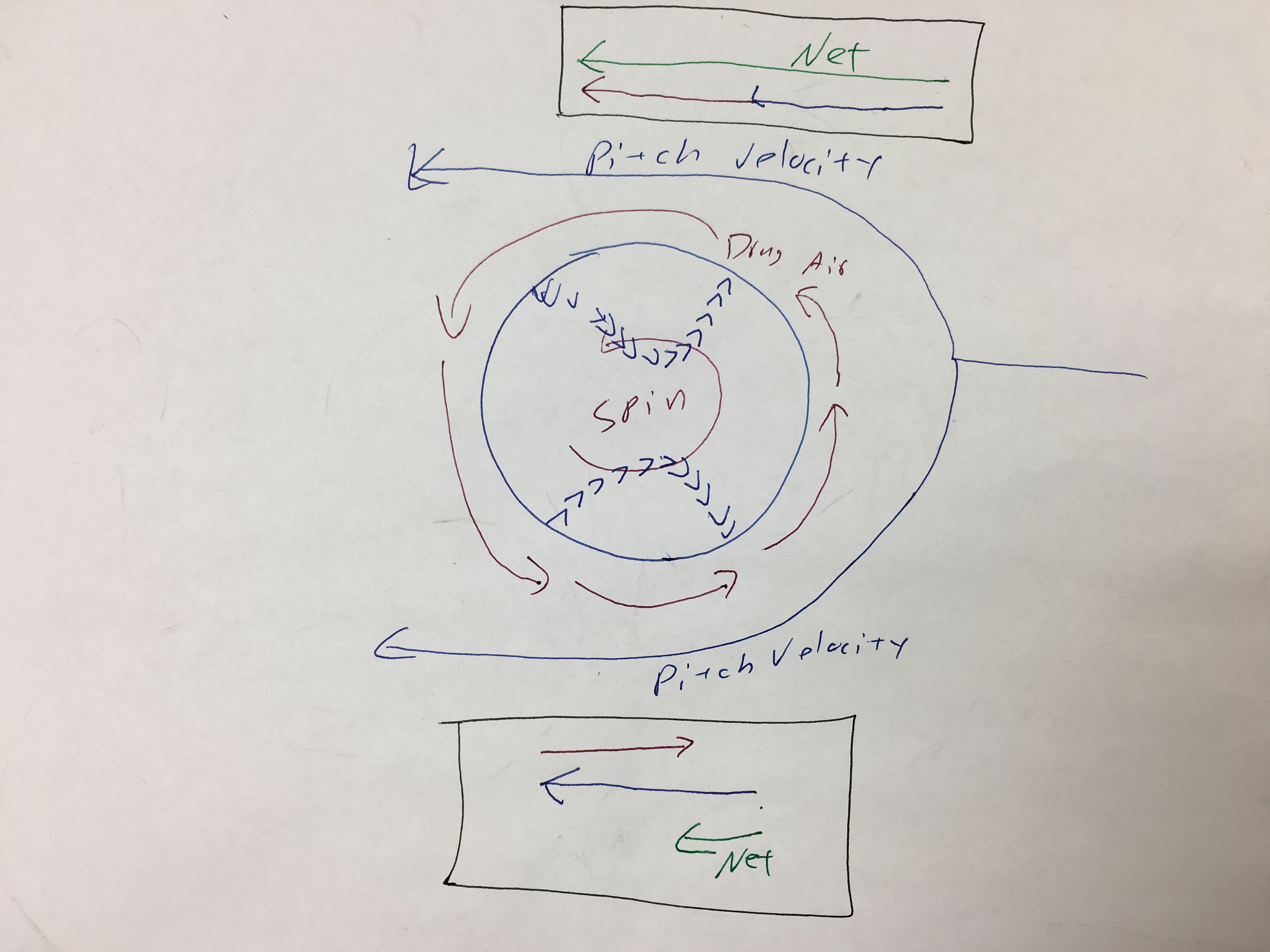
The result is that one side of the ball has high pressure and the other side has low pressure. The difference in pressure creates a force. The air pressure difference pushes the ball form the high pressure region to the low pressure region. 
That is to say there is a force acting in the direction of the low pressure. Given Newton's Second Law, it is known that F=ma, so where there is a net force, the ball must accelerate (change velocity) in the direction of the force.
Thus, the rate of acceleration can be found based on some function of the difference in pressure (F) divided by the mass of the ball:
a = ƒ(p1 and p2)/m
So, what can a pitcher do to make the ball curve? Well… you can't control the mass of the ball. You can control, however the spin.
Since the air moving around the ball due to it moving is the same on all sides, the spin accounts for the difference in pressure. Both p1 and p2 are affected by the spin
The net air flow is on one side pitch velocity + drug air.
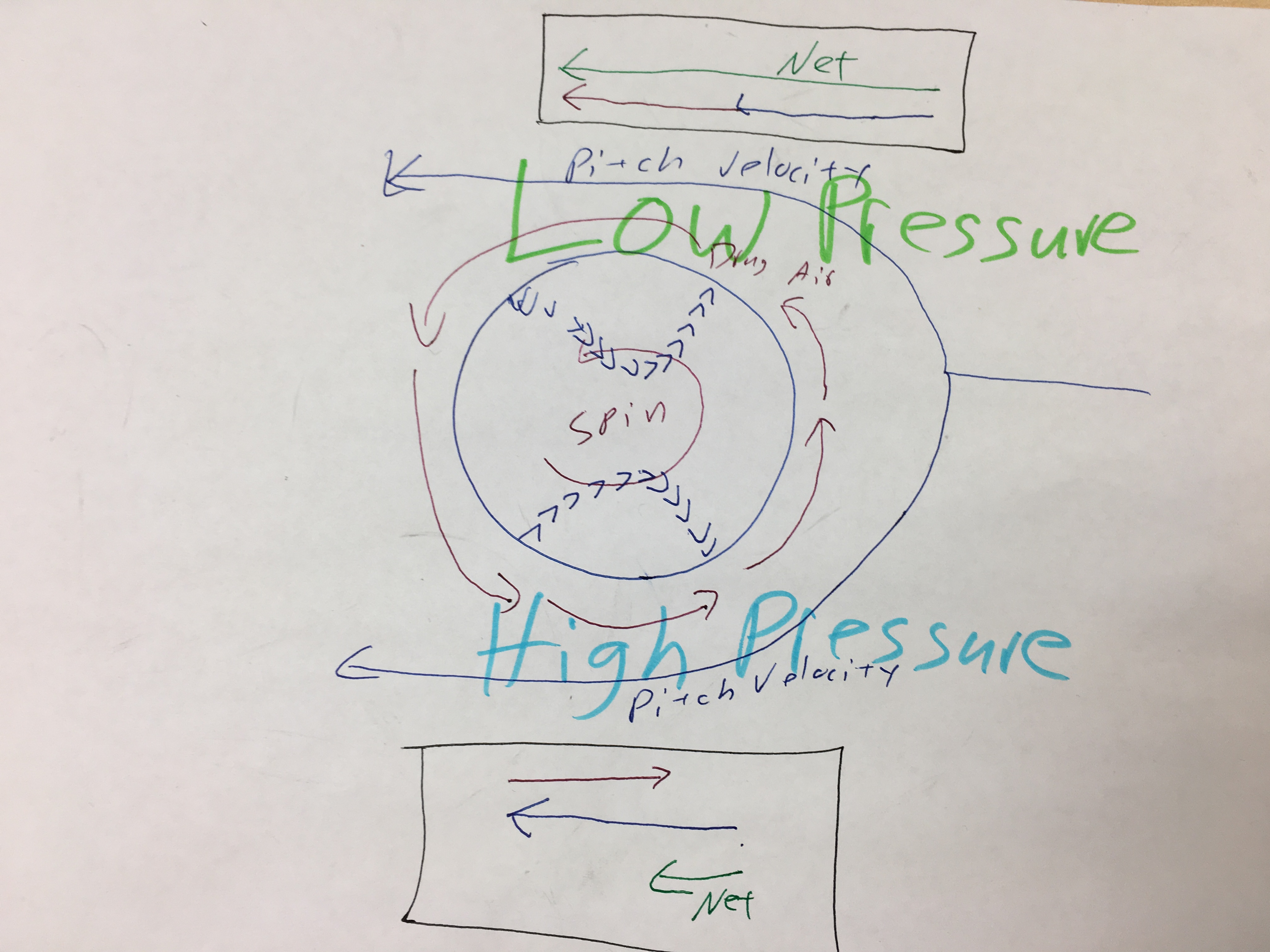
The net air flow on the other side is pitch velocity - drug air.
Thus, since the difference in pressure is a result of the DIFFERENCE in the net velocities of the air on opposite sides of the pitch path, the more spin, the bigger the difference in pressure.
AND, then, the bigger the difference in pressure (back to the math)…
a = ƒ(p1 and p2)/m
…the greater the rate of acceleration.
By controlling the spin allows a pitcher to control where the high and low pressure zones are. The ball will break into the low pressure zone.
A pitch, then, with backspin, will dive. If the rotation is the other way (e.g. a good overhand throw), the ball will actually float some and the effect of gravity will be lessoned.
The LESS the axis of rotation aligns with the path of the ball, the GREATER the affect of the spin on the ball's path.
Conversely, if the axis of rotation aligns with the path of the ball's movement, then the affect of the spin is zero. Think of a spiral football pass. IF the pass/punt spirals properly, the affect of the spin is zero.
An overhand fastball rotates back toward the pitcher. Thus, there is low pressure on top of the ball.
An underhand fastball (or a topspin tennis shot) rotates forward toward the batter. Thus, there is low pressure on the bottom of the ball.
Cutters, sliders, etc have various spins that move the low pressure zone to different places on the ball.
CONCLUSION:
1.) Since the rate at which a ball's velocity changes can be found by
a = ƒ(p1 and p2)/m
and since the difference in pressures is caused by the spin, then changing the direction and rate of the spin will change the direction and rate of the acceleration (of the break).
2.) Increasing the rate of spin increases the difference in pressures. The greater the difference in pressure, the more the ball with break (accelerate).

Additional Notes:

1.) The diameter of the ball affects the velocity of the spinning surface. Thus, two balls of the same mass spinning at the same rate, but having different diameters will break differently. For example, a huge beachball with the same mass as a volleyball will curve more with the same spin.

Tuesday, May 1, 2018

Friction: A Force That Opposes Motion

Newton's Second Law leads to the formula that connects force, mass, and acceleration:

F = ma

Earlier, it was explained that there are only four fundamental forces, but that every other force that is easily observed is derived from them. Thus, friction can be understood as a force which arises due to the interaction of the atoms between two objects when they are in contact. The strong, weak, and electromagnetic forces work such that there is a resistive force when one object slides across another.

A resistive force (also know as oppositional force) works in the opposite direction of the active forces, such as pushing or pulling something.

Before working with friction, there are two more concepts that need to be understood:

Weight

Weight is the force created by gravity and its magnitude can be found by multiplying the mass of an object by the rate at which gravity accelerates things. On earth, for introductory physics students,. the value for acceleration due to gravity of 9.8 (m/s)/s or 9.81 (m/s)/s is commonly used.

In the metric system, the Newton is the unit for weight. The pound is also a unit of weight*.

The direction for weight is always "down." That means that (when on earth) weight always acts in direction that is perpendicular to the horizon and toward the center of the earth.

Normal Force

The concept of Normal Force is easy to understand. Calculating the normal force (which is usually indicated as Fn) requires using trigonometry EXCEPT when the surface on which an object slides is level (has an angle to the horizon of zero).

The formal force (Fn) is defined as the component of the weight (mg) of an object that is perpendicular to a surface. When the surface is level ALL of the normal force is perpendicular to the surface. That makes things easy. Thus, the normal force IS THE WEIGHT, but this is ONLY true with the surface is level (has and angle to the horizon of zero).

When the surface is NOT level, then, math…

Fn is labeled, and it is clear that it pushing the box in a direction that is perpendicular to the surface of the inclined plane.

Note that F3 is perpendicular to the horizon. That would mean that F3 is the weight or is found as m•g where m is the mass and g is acceleration due to gravity.


Force of Friction

There are two types of friction. One is when an object is already sliding. One is when the object is at rest. They are cleverly named sliding friction and static friction.

Sliding friction is sometimes indicated as fk where the k stands for kinetic (which means moving) and static friction is indicated as fs.

NOTE: in this nomenclature, the fi is lowercase. the k and the s may or may not be subscripted, depending on the type-setting process. 

Intuition will tell you that pushing something over ice is easier than pushing it over asphalt. There therefore must be some way to indicate the degree of slipperiness an object has (or stickiness).

There is. It is called the coefficient of friction. And there are two sets of coefficients: one for each type of friction. Sliding and static coefficients of friction are abbreviated as µk and µs respectively.

 Here is a link that will allow you to look at coefficients of friction for various materials:

https://www.engineeringtoolbox.com/friction-coefficients-d_778.html

Calculating the Force of Friction

So, using all those concepts, calculating the force of friction becomes pretty simple. Friction can be found by multiplying the normal force by the coefficient of friction:

fk = (Fn)(µk)

EXAMPLE

Clean dry steel sliding on steel has a coefficient of friction of μ = 0.78. If a block with a mass of 4 kg slides across, what is the force of friction.

First, calculate the normal force:

Fn = mg
Fn = (4)(9.8)
Fn = 39.2


Now, use Fn to find the force of friction.

fk = (Fn)(µk)
fk = 39.2 • 0.78

fk = 30.576 N


_________________
*The English system unit for mass is called the Slug and is approximated by taking the weight of something and dividing by 32. So a 110 pound person would have a mass of 3.4 slugs.

About Me

My photo
Bill Snodgrass is a life-long teacher/mentor type who likes to see people develop into their best possible selves.