Where are we going with this? The information on this page should increase understanding related to the discussion of chemical reactions in biology.
(Hmm… this must be about reactions…)
reactants and products.
H20
Basic science information presented in an accessible, easy-to-understand manner.
Where are we going with this? The information on this page should increase understanding related to the discussion of chemical reactions in biology.
reactants and products.
H20
Where are we going with this? The information on this page should increase understanding related to this standard: Model and understand aerobic respiration demonstrating the flow of matter and energy out of a cell and explain energy transfer systems. Also, compare aerobic respiration to alternative processes of glucose metabolism.
It "is a central driver of cellular respiration. It takes acetyl CoA—produced by the oxidation of pyruvate and originally derived from glucose—as its starting material and, in a series of redox reactions, harvests much of its bond energy in the form of NADH, FADH2, and ATP molecules. The reduced electron carriers—NADH and FADH2—generated in the TCA cycle will pass their electrons into the electron transport chain and, through oxidative phosphorylation, will generate most of the ATP produced in cellular respiration (Source 2021-11).
![]() |
| Source, 2021-11 |
Glycolysis is an anaerobic reaction taking place in the cytosol. If there is no oxygen present, then fermentation occurs. But!!! If oxygen is present, then it passes two 3-carbon pyruvate (pyruvic acid) on to the Krebs cycle. |
aerobic - with oxygen anerobic - without oxygen |
![]() |
| Source 2021-11 |
![]() |
| Source, 2021-11 |
Where are we going with this? The information on this page should increase understanding related to this standard: Model and understand aerobic respiration demonstrating the flow of matter and energy out of a cell and explain energy transfer systems. Also, compare aerobic respiration to alternative processes of glucose metabolism.
"Cellular respiration is a set of metabolic reactions and processes that take place in the cells of organisms to convert chemical energy from oxygen molecules or nutrients into adenosine triphosphate, and then release waste products (Source, 2021-11).
C6H12O6 + 6O2 ---->
----> 6CO2 + 6H2O + ATP
Even more, fancier?
Enough already! Let's get on with Cellular Respiration, okay?
Let's have a look at the flow of… stuff… through cellular respiration… One more time!
In the beginning, there was photosynthesis that produced glucose…
…then…
1. Glycolysis (occurring in the cytosol)… (Wait… what is cytosol?) See More Notes at the end of the page.
![]() |
| Source, 2021-11 |
2. Krebs Cycle (occurring in the mitochondria)… (also called citric acid cycle)
3. Electron Transport System (occurring in the mitochondria)…
Wow… just… wow!
Okay, so we have three steps. Normally, the three steps are looked at according to a specific classification.
The 3 steps are classified by whether they require oxygen or not.
If they do require oxygen, they are called aerobic.
If they do not require oxygen, they are called anaerobic.
Glycolysis is anaerobic, which means it happens without oxygen. The Krebs cycle and ETC are aerobic, which means they need oxygen in order to function.
If you are undergoing anaerobic respiration, you cannot gain the ATP from the processes that are aerobic.
![]() |
| Source, 2021-03 |
Where are we going with this? The information on this page should increase understanding related to this standard: Understand how photosynthesis turns light energy into chemical energy.
ATP (Adenosine triphosphate, C10H16N5O13P3)NADPH (Nicotinamide adenine dinucleotide phosphate, C21H29N7O17P3)CO2 (Carbon dioxide)
![]() |
| Source, 2021-10 |
C10H16N5O13P3 + H2O --> C10H15N5O10P2 + PO4-3
Requires carbon dioxideMakes ADP and NADP+ to go back to light dependent rxns.Releases glucose.
![]() |
| Source 2021-11-01 |
![]() |
| Source 2021-10-25 |
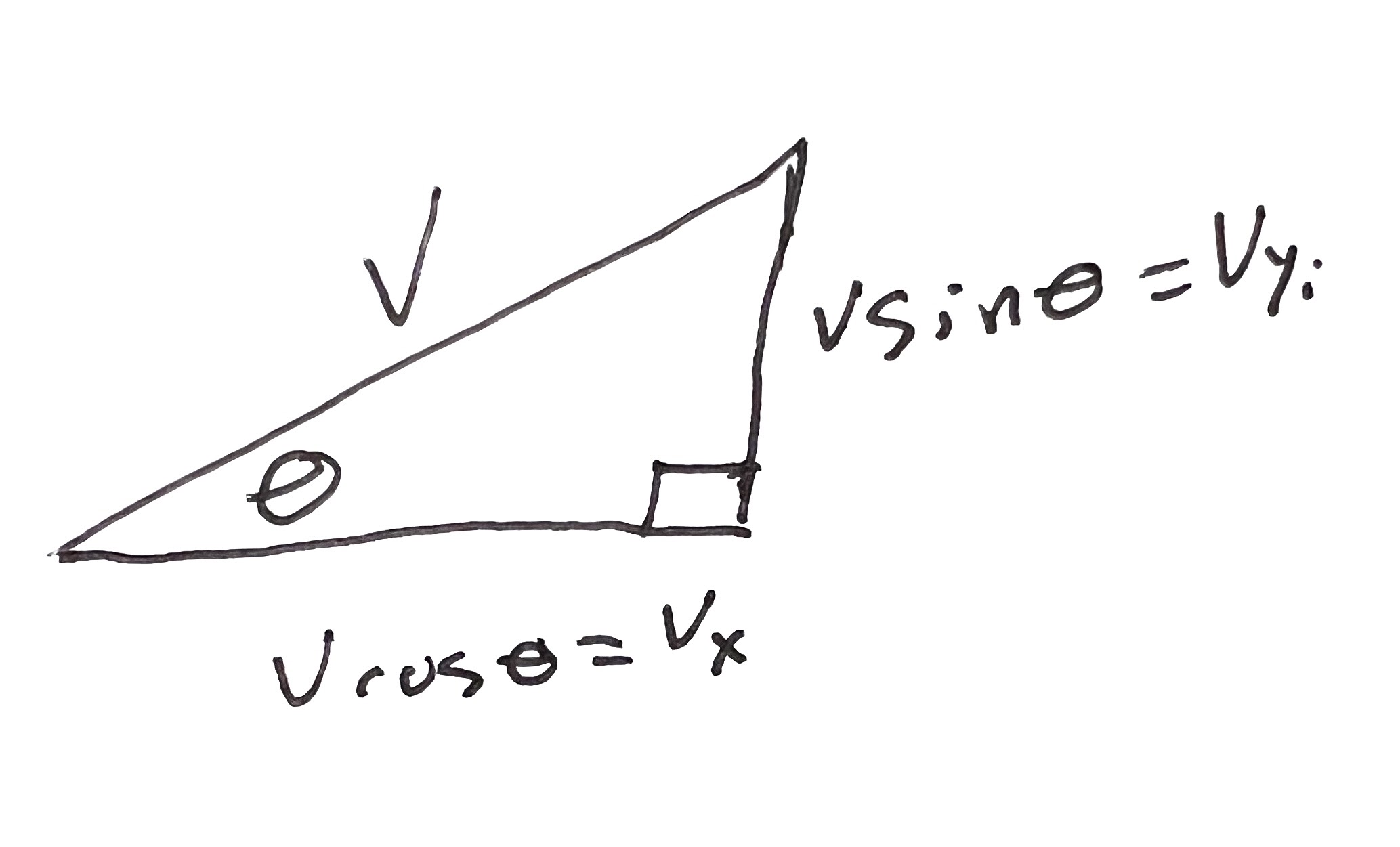
v • cosθ = vx
v • sinθ = vyi
vf = vi + at
Plug in for the specific situation…
0 = vyi + (-9.81)tup-vyi = -9.81•tup-vyi /-9.81 = tup
vyi /9.81 = tup
df = di + vit + 1/2at2
Plug in for specific case:
dy(max) = dyi + vyi•tup + 1/2at2
df = 0 m (the ground)
di = dy(max)
vi = 0 m/s (because we are measuring from when it stopped going up, max distance in y direction)
a = g = -9.81 m/s/s (or -9.8 m/s/s)
t = tdown
df = di + vit + 1/2at20 = dy(max) + 0 • tdown + 1/2(-9.81) tdown2-dy(max) = -4.905 tdown2-dy(max) / -4.905 = tdown2
tdown = √ (dy(max)) / 4.905
ttot = tup + tdown
di = dxi = 0
vi = vx (From Step 2)
a = 0
t = ttot
1. Draw it out and find vx and vyi…2. Make a box in which you will find dx (at the end of the process)3. Figure out the time up and time down then go back to the box…
v • cosθ = vxv • sinθ = vyi
tup = vyi / 9.81
Find the time down:
• #4 Find how high it goes
tdown = √ dy(max) / 4.905
ttot = tup + tdown
dx = vx•ttotwhere vx was found in step 2 and t was found in step 4.
Something like this…
| The scribbling above follows the steps without labeling them with numbers. Go down the left, the back up and down the right. |
v • cosθ = vxv • sinθ = vyi
tup = vyi / 9.81
Find the time down:
• #4 Find how high it goes
tdown = √ dy(max) / 4.905
ttot = tup + tdown
dx = vx•ttotwhere vx was found in step 2 and ttot was found in step 4.