Search This Blog

Friday, November 12, 2021

Electron Transport Chain

Biology Index

Where are we going with this? The information on this page should increase understanding related to this standard:  Model and understand aerobic respiration demonstrating the flow of matter and energy out of a cell and explain energy transfer systems. Also, compare aerobic respiration to alternative processes of glucose metabolism.

Article includes ideas, images, and content from Troy Smigielski (2021-10)

Electron Transport Chain
(Chains? So, no cycle and all that going around and around?)


So, how many names does this thing have?

At least three!

"The electron transport chain (ETC; respiratory chain) is a series of protein complexes that transfer electrons from electron donors to electron acceptors via redox reactions (both reduction and oxidation occurring simultaneously) and couples this electron transfer with the transfer of protons (H+ ions) across a membrane. The electron transport chain is built up of peptides, enzymes, and other molecules…" (Source, 2021-11).

Am I supposed to understand any of that! 

Let's try to get a handle on that. So…

The electron transport chain is the final step in cellular respiration. 
  • It receives electron carriers from the Krebs cycle and uses them, along with oxygen (hence it is aerobic), to create ATP which is passed on to the cell to provide energy for cellular functioning.
  • The process takes place in the inner membrane of the mitochondria. 
  • It produces water as a byproduct.
Nice! Can we just stop now?

The whole process begins with glycolysis


that sends pyruvate (which is broken down into acetyl CoA first) to the Krebs cycle.


The Krebs cycle creates and sends electrons to the electron transport chain. The electron carriers are NADH and FADH2.

The Krebs cycle is considered to be anaerobic. Why? 

It is part of a system that includes the electron transport system that, we will see later, needs oxygen. So, because without oxygen, the ETC cannot use the electrons from NADH and FADH2. If they can’t drop off electrons, they can’t become NAD+ and FAD. Without NAD+ and FAD, the Krebs cycle cannot function. Therefore, the Krebs cycle indirectly requires oxygen.

At the end of the Krebs cycle, the are sent to the electron transport chain to be converted into ATP.


The ETC
is the final step of cellular respiration. We further discussed that it occurs in the mitochondria and that it is aerobic.

Okay… about those names…

It is also called oxidative phosphorylation.
Seriously! Stop!

“Oxidative” refers to oxidation, which is when a molecule loses an electron. Phosphorylation” refers to the attachment of a phosphate to ADP, which makes ATP.

Now, recall that the overall, main purpose of cellular respiration is to create ATP!

Source 2021-11
In discussing glycolysis and the Krebs cycle, we previewed the role of the electron transport chain and learned that it is responsible for the bulk of ATP produced. 
How? 

The ETC is located in the inner membrane of the mitochondrion.

The electron transport chain will use electrons that are dropped off by NADH and FADH2 to create ATP. 
  • Each NADH can produce 3 ATP.
  • Each FADH2 can produce 2 ATP.

Steps of the Electron Transport Chain

  • Electrons are brought to the ETC by NADH and FADH2.
  • When electrons are dropped off, the Hydrogen that they are attached to is dropped off too. 
  • Therefore, when electrons are dropped off, NADH becomes NAD+ and FADH2 becomes FAD.


NAD+ and FAD go back to glycolysis and Krebs Cycle to pick up more electrons and keep the process going.

As more H+ ions and electrons are dropped off, H+ ions start to build up in the intermembrane space. Naturally, they want to diffuse out, but they are charged. Therefore, they must exit through a transport protein via facilitated diffusion.


The transport protein that allows the H+ ions to leave is called ATP Synthase. When this happens, ATP Synthase spins which provides enough energy to create ATP. When this happens, ATP Synthase spins which provides enough energy to create ATP.

Meanwhile, the electrons travel down the ETC and release energy.

This energy is used to push more H+ ions out because the more H+ ions that go out, the more H+ ions must come back in through ATP Synthase. This forces your cell to produce more ATP.

At the end of the chain, the electrons are fresh out of energy. They are “accepted” by oxygen. 


In other words, oxygen is the final electron acceptor.

Some H+ ions attach to the electron and oxygen, which forms water.

The Totals

  • About 36-38 total ATP are made in cellular respiration.
  • Remember, 2 ATP were used in glycolysis.
  • The net gain of ATP in cellular respiration is 34-36 ATP.
  • Glycolysis: 2 ATP (anaerobic)
  • Citric Acid Cycle + ETC: ~34 ATP (aerobic)

Despite the entirety of the system, some energy is left in the original glucose molecule. The energy in glucose that is not used to make energy is lost as heat, which helps keep our bodies at homeostasis.


Tuesday, November 9, 2021

About Reactions

Biology Index

Where are we going with this? The information on this page should increase understanding related to the discussion of chemical reactions in biology.

About Reactions
(Hmm… this must be about reactions…)

Many topics in biology include the need to understand chemical reactions. So… let's discuss this!

A chemical reaction basically is taking some things and causing them become different things. More accurately, a chemical reaction is when an interaction involving substances and energy result in the production of one or more DIFFERENT substances.

Let's use the main photosynthesis reaction as an example.

Starting with carbon dioxide and water, light energy is used to produce glucose and oxygen.

There are, in any reaction two types of substances:

reactants and products.

So, let's take the above sentence and say it in a way that make it clear what are reactants and what are products. Also, let's add color!

Carbon dioxide and water react to produce glucose and oxygen.

So:
the reactants are carbon dioxide and water.
to produce indicates that a reaction occurred
glucose and oxygen are the products.

While there are chemical symbols for most reactions, in biology, the discussion sometimes is more conveniently carried on using the names of the substances. However, sometimes the chemical symbols are used. Let's look at that:

Carbon dioxide and water react to produce glucose and oxygen.
                                    CO2 + H2O ---> C6H12O6 + O2

Molecules are the string of letters and subscripts connected to each other without spaces. The letters come from the periodic table, are the atomic symbols. The little numbers are the subscripts which indicate how many of each type of atom are present in each molecule.  The ---> symbol indicates that the reaction took place.

Some sources will not make the subscripts small, so you might see something like this:

H20

In any case, the number in the middle or at the end of molecular notation applies ONLY to the element that comes immediately before it. Hence, in H2O, the 2 only applies to the H.

So, in H2O, there are 2 H atoms and 1 O atom.

To be most accurate, symbolic notations will include numbers called coefficients which indicate how many of each type of molecule is present. Let's have a look!

Carbon dioxide and water react to produce glucose and oxygen.
                                    6CO2 + 6H2O ---> C6H12O6 + 6O2

This notation means that it takes 6 molecules of carbon dioxide and 6 molecules of water make the reaction run.

Discussing biological reactions frequently attempt to describe what "goes in and what comes out."

So… Let's get our fancy color coded example again!


                                            PHOTOSYNTHESIS

Carbon dioxide and water react to produce glucose and oxygen.
                                 6CO2 + 6H2O  --->     C6H12O6 + 6O2
                                    Reactants   yield   Products
                                      Goes in       --->      Comes out


Monday, November 8, 2021

Krebs Cycle (Citric Acid Cycle)

Biology Index

Where are we going with this? The information on this page should increase understanding related to this standard:  Model and understand aerobic respiration demonstrating the flow of matter and energy out of a cell and explain energy transfer systems. Also, compare aerobic respiration to alternative processes of glucose metabolism.

Article includes ideas, images, and content from Troy Smigielski (2021-10)


Krebs Cycle (Citric Acid Cycle)
(This sounds like something off of Sponge Bob!)

Source, 2021-11

So, this process has three names, actually!

Krebs Cycle = Citric Acid Cycle = tricarboxylic acid cycle
(Must be important!)

Also, I head this guy on YouTube call it the Hans cycle, because that was Krebs' first name… Hans Krebs. So, yeah… That…

The Krebs cycle is a part of cellular respiration by which adenosine triphosphate (ATP) is produced. It's… complicated! 

It "is a central driver of cellular respiration. It takes acetyl CoA—produced by the oxidation of pyruvate and originally derived from glucose—as its starting material and, in a series of redox reactions, harvests much of its bond energy in the form of NADH, FADH2, and ATP molecules. The reduced electron carriers—NADH and FADH2—generated in the TCA cycle will pass their electrons into the electron transport chain and, through oxidative phosphorylation, will generate most of the ATP produced in cellular respiration (Source 2021-11).

Source, 2021-11
The whole goal of cellular respiration is to produce ATP that can be used to power cellular functioning. 


The Krebs cycle is one of the three steps, the middle step, in cellular respiration. 

Although it is complicated at a bio-chemical process, let's see if we can break it down into less complex steps!


If, in cellular respiration, we take a step backward from the Krebs cycle, we are in glycolysis.
Glycolysis is an anaerobic reaction taking place in the cytosol. If there is no oxygen present, then fermentation occurs. But!!! If oxygen is present, then it passes two 3-carbon pyruvate (pyruvic acid) on to the Krebs cycle.

aerobic - with oxygen

anerobic - without oxygen

Recall that glycolysis begins with glucose.
And… recall that glucose (along with oxygen) is produced by photosynthesis.

As discussed above, glucose is a six carbon molecule that is broken down in glycolysis. The process produces a net gain of 2 ATP, then passes 2 pyruvate to the Krebs cycle. 

Whereas glycolysis is anaerobic (and… you know… takes place in the cytosol), the Krebs cycle takes place in the mitochondria and is aerobic.

In between glycolysis and the Krebs cycle, the pyruvate (the pyruvic acid molecules) breaks down to produce one NADH and one CO2, leaving behind a 2-carbon molecule.

This 2-carbon molecule is called Acetyl CoA, and this is what is taken into the Krebs cycle. 


At this point, we are ready to start looking at the Krebs cycle.


Source 2021-11

The Krebs cycle occurs in the mitochondrion. Specifically, the Krebs Cycle takes place in the matrix inside the mitochondrion.

The matrix is the space inside the organelle… kinda like a curvy track.

Recall that between glycolysis and the Krebs cycle, the pyruvate molecules are turned into acetyl CoA, a 2-carbon molecule.

Before the Citric Acid Cycle begins, one pyruvate (3-C) from glycolysis is converted into Acetyl CoA (2-C) so the cycle can begin. This creates one CO2 that will go into the atmosphere. This also creates one NADH.

So, just getting ready to start the Krebs cycle, on of the electron carriers, NADH, and on CO2 have been created.


Source, 2021-11

The most important function of the Krebs cycle is to energize the electron carriers and send them to the electron transport chain. The electron transport chain will use the electron carriers to produce… a lot of ATP!

There are two electron transport molecules in cellular respiration. They are usually called electron carriers. Why? Because the… carry electrons! 

One of the two electron carriers in cellular respiration might remind you of the electron carrier in photosynthesis. It is NADH. (In photosynthesis, the electron carrier is NADPH.) The other electron carrier in cellular respiration is called FADH2. So, for cellular respiration, the electron carriers are NADH and FADH2.


The Krebs cycle is the source for most of the NADH and FADH2 that will be used in the electron transport chain.

Next, entering the Krebs cycle, Acetyl CoA (2-C) combines with oxaloacetate (4-C) to form citric acid (6-C).

After rearrangement, citric acid releases two of its Carbons as CO2 into the atmosphere.

As each CO2 leaves, one NADH is also produced. So, if 2 CO2 are released, then 2 NADH are also produced.

These CO2  molecules are exhaled and released into the atmosphere. They are byproducts not needed by the cell.

The remaining four carbons go through reactions to regenerate oxaloacetate so that the cycle can repeat. In the regeneration process, one ATP, one NADH, and one FADH2 are made.

One round of the Krebs cycle produces:
  • 2 CO2
  • 3 NADH
  • 1 FADH2
  • 1 ATP
These numbers are for one round. One round started with only one pyruvate. Remember, one glucose at the beginning makes 2 pyruvate. Therefore, we need to multiply these numbers by 2 to see the total number of each product that are made by one glucose molecule.

One molecule of glucose produces:
  • 4 CO2
  • 6 NADH
  • 2 FADH2
  • 2 ATP
The energy in these electrons that are carried by NADH and FADH2 will go the the ETC (Step 3 of the cellular respiration process) to help produce many more molecules of ATP.

Wednesday, November 3, 2021

Glycolysis

Biology Index

Where are we going with this? The information on this page should increase understanding related to this standard:  Model and understand aerobic respiration demonstrating the flow of matter and energy out of a cell and explain energy transfer systems. Also, compare aerobic respiration to alternative processes of glucose metabolism.


Article includes ideas, images, and content from Troy Smigielski (2021-10)

Glycolysis
(Someone should come up with a spicer name for this!)


Glycolysis is the first step in cellular respiration. Of the three steps it is different in a couple of ways:
  • It does not require oxygen, which makes it anaerobic.
  • It occurs in the cytoplasm (the cytosol) of the cell; not the mitochondrion.

In cellular respiration, you’ll notice that if the process is anaerobic, then it will happen outside of the mitochondrion.

Conversely, if it is aerobic, it will happen in the mitochondria.

Before we get too far, let's recall a few things. Keep in mind that…

… glucose is one of the reactants of cellular respiration. Where does the glucose come from? You will recall that plants make glucose as a product of photosynthesis

Don't forget the main purpose of cellular respiration (of which glycolysis is a step) is to convert the energy stored in glucose into energy stored as ATP. In other words, cellular respiration breaks down glucose and turns it into ATP.

If this process breaks down glucose, what does our starting material have to be?

Glycolysis starts with one glucose molecule.

Okay… fancy word… Lysis means to break.

So, glycolysis means “glucose broken”.


Using 2 ATP, the glucose molecule is broken into two 3-C molecules. (Wait! I thought we were trying to MAKE ATP. Are we doing this backwards?)

Next, 4 ATP and electrons are extracted from the two 3-C molecules. The electrons are placed onto NAD+, and this creates NADH, which is one of the electron carriers in cellular respiration.

(So… NADH… is that like the NADPH in photosynthesis?)

Just as the NADPH in photosynthesis carried electrons, the NADH carries electrons throughout cells as needed. NADH, is an electron carrier.

Electron carriers function to carry electrons around the cell. It is these NADH molecules that are used to transport electrons to the ETC (Step 3).

This extraction of ATP and electrons turns the 3-C molecules into pyruvate (pyruvic acid).

In basic terms, glycolysis turns glucose into 2 pyruvate.

But, it also makes some ATP and and NADH.

Staring with one glucose molecule at the beginning, by the end of glycolysis, the following have been produced:
  • 2 pyruvate (2 pyruvic acid)
  • 2 NADH
  • 2 ATP (2 where used up and 4 were created, so you end up with a net gain of 2, because math. )


During glycolysis, 2 ATP molecules are used. However, by the end of the process, 4 ATP molecules are created. So, if you lose 2 but gain 4, there is a net gain of +2 ATP.


What happens after glycolysis?


Normally, your body uses oxygen after glycolysis to go on to the Krebs Cycle. However, when oxygen is not available, your body resorts to fermentation.


Fermentation

Since fermentation happens in the absence of oxygen, is it aerobic or anaerobic?

Since fermentation happens when no oxygen is available, that makes this process anaerobic. Considering it does not require oxygen, this also happens in the cytoplasm of the cell. If a process is anaerobic, it will happen in the cytoplasm.

But… why? Why is this a thing?

In order for an organism to survive, it needs energy. The goal of fermentation is to keep glycolysis going so your body can still get at least 2 ATP because you have no other source of ATP without oxygen.

To do this, fermentation converts NADH back into NAD+ so that glycolysis can start again in order to produce those 2 ATP. 

If the NADH molecules cannot go to the ETC, then they are essentially useless. So, your body finds a use for them.

There are 2 main types of fermentation in nature:
  • Alcoholic - occurs in bacteria and yeast
  • Lactic acid - occurs in humans (animals)
In humans, the lactic acid pathway provides your body with small amounts of ATP during intense exercise. Remember, this is anaerobic, so it happens when your muscles’ oxygen demand is greater than the oxygen supply.

So, if skeletal muscles are used (such as during vigorous exercise) when there is not enough oxygen, they produce lactic acid instead of carbon dioxide.

Because this process only produces 2 ATP, this cannot keep you going for a long time.

As this pathway continues, lactic acid builds up in the body. This gives you a burning sensation and can cause nausea and vomiting.

Um… I suppose there must be some way to get rid of lactic acid build up?

To get rid of this lactic acid buildup, you simply need to rest and breathe.


Tuesday, November 2, 2021

Cellular Respiration Overview

Biology Index

Where are we going with this? The information on this page should increase understanding related to this standard:  Model and understand aerobic respiration demonstrating the flow of matter and energy out of a cell and explain energy transfer systems. Also, compare aerobic respiration to alternative processes of glucose metabolism.


Article includes ideas, images, and content from Troy Smigielski (2021-10)

Cellular Respiration Overview
(Wait! Are we talking about phones again?)


While idea of breathing smartphones is intriguing… nah…

"Cellular respiration is a set of metabolic reactions and processes that take place in the cells of organisms to convert chemical energy from oxygen molecules or nutrients into adenosine triphosphate, and then release waste products (Source, 2021-11).

What does that mean?


Alright, think about a few things and let's see where we end up!

Glucose is created in photosynthesis.

Humans don’t necessarily use that exact glucose, but we do consume glucose as a basic unit of energy.

To gain energy (ATP is the energy cells need) from the glucose, it needs to be broken down.


Thinking about photosynthesis, we can summarize:

6CO2 + 6H2O   ---->   C6H12O6 + 6O2

The products of photosynthesis are the reactants of cellular respiration.

C6H12O6 + 6O2   ---->   6CO2 + 6H2O + ATP


In essences, ATP is used up in photosynthesis to make glucose and glucose is used up in cellular respiration to make ATP. And… ATP is the substance that powers cellular functions (including muscle contractions).


Photosynthesis provides
oxygen for cellular respiration to happen. Photosynthesis also produces glucose, but this glucose is not always the direct source of the glucose needed in C.R.

Cellular respiration provides carbon dioxide, CO2, for photosynthesis to happen. Cellular respiration also produces water, but this water is not the direct source of the water needed in photosynthesis.

Thus, we can say that Photosynthesis and cellular respiration work together in a cycle.


Once more, think a little…

What is the main goal of photosynthesis?

If photosynthesis and cellular respiration are the opposites, what do you think the main goal of cellular respiration is? 

The main goal of photosynthesis is to build sugars. The main goal of cellular respiration is to extract energy in the form of ATP by breaking down sugars. That is to say, cellular respiration creates ATP by breaking down sugars.

In cellular respiration, we create:

  • CO2 which is exhaled
  • water
    (these are byproducts) 

  • and the real goal, ATP as a source of energy.

Most of this process happens in the mitochondrion.

There are three major steps in cellular respiration.


The 3 steps in cellular respiration are:
  1. Glycolysis
  2. Krebs cycle (which is also called the Citric Acid Cycle)
  3. Electron transport chain (ETC)
Glycolysis happens outside of the mitochondrion in the cytosol. The remaining steps—the Krebs cycle and the Electron transport change take place in the mitochondrion. Regardless of where they happen, all 3 steps of cellular respiration create ATP (energy).


Reactants and Products
    Inputs       and     Outputs

Look at the diagram (above and below) and consider what goes in and what comes out?

Notice…

C6H12O6 + 6O2   ---->

Going in (reactants) are Glucose (C6H12O6) and Oxygen (O2)
  • Glucose is used in the glycolysis step
  • Oxygen goes in to the Electron transport chain step
---->   6CO2 + 6H2+ ATP

Coming out (products) are carbon dioxide (CO2,) water (H2O), and ATP:
  • Carbon dioxide is a product of the Krebs cycle step. (Krebs cycle is also called the citric acid cycle)
  • Water is a product of electron transport chain step.
  • ATP is a product of all three steps.


In-between substances include Pyruvate and the compounds dealing with the electron movement, NADH and FADH2.

Pyruvate is produced through glycolysis and is passed on to the mitochondrion.

You should also notice that there are some electrons e- and hydrogen ions H+ that move around…

The electron carriers in cellular respiration are NADH and FADH2.

More information on NADH can be found here. Likewise more information on FADH2 can be found here.

Even more, fancier?

Enough already! Let's get on with Cellular Respiration, okay? 


Let's have a look at the flow of… stuff… through cellular respiration… One more time!

In the beginning, there was photosynthesis that produced glucose…

…then…

1. Glycolysis (occurring in the cytosol)… (Wait… what is cytosol?) See More Notes at the end of the page.

Source, 2021-11
  • takes in glucose and breaks it down
  • producing a little ATP, some NADH, and Pyruvic Acid
  • and passing the Pyruvic acid on to the Krebs Cycle
  • and passing the NADH on to the Electron Transport System
  • and then provides the ATP to the cell for other cellular functions.

2. Krebs Cycle (occurring in the mitochondria)… (also called citric acid cycle)

  • takes in Pyruvic Acid and
  • producing ATP and NADH
  • and passing the NADH on to the Electron Transport System
  • and passing the NADH on to the Electron Transport System
  • and producing a waste byproduct (carbon dioxide) 
  • and then provides the ATP to the cell for other cellular functions.

3. Electron Transport System (occurring in the mitochondria)…

  • takes in NADH and oxygen
  • producing ATP
  • and producing a waste byproduct (water) 
  • and then provides the ATP to the cell for other cellular functions.

Source, 2021-11

Wow… just… wow!


Okay, so we have three steps. Normally, the three steps are looked at according to a specific classification.

The 3 steps are classified by whether they require oxygen or not.

If they do require oxygen, they are called aerobic.

If they do not require oxygen, they are called anaerobic.


Glycolysis is anaerobic, which means it happens without oxygen. The Krebs cycle and ETC are aerobic, which means they need oxygen in order to function.

 If you are undergoing anaerobic respiration, you cannot gain the ATP from the processes that are aerobic.


_________________________
MORE NOTES

What is Cytosol?

Source, 2021-03

The cytosol is the liquid medium contained within a cell. The cytosol is a component of the cytoplasm. The cytoplasm includes the cytosol, all the organelles, and the liquid contents inside the organelles. ... The main component of cytosol is water. (Source, 2021-03)


The Whole Process!


Wednesday, October 27, 2021

Light Independent Reactions

Biology Index

Where are we going with this? The information on this page should increase understanding related to this standard:  Understand how photosynthesis turns light energy into chemical energy.

Article includes ideas, images, and content from Troy Smigielski (2021-10)

Light Independent Reactions
(…and then… BAM! Magic!)

The photosynthesis process includes two distinct steps. The light dependent reactions and the light independent reactions. The net result of photosynthesis is the production of oxygen that is released and sugar that is stored to be used by the plant.

The light dependent reactions produce oxygen that gets released by the plant as a byproduct. It also produces ATP and the electron carrier NADPH which are used in the Light Independent Reactions.

Keep in mind that the oxygen produced in the light dependent reactions is NOT needed by the plant. It is a byproduct that is given off. 

The goal of LDR is to create energy rich molecules for the Calvin cycle to use.

The light independent reactions are also called the Calvin cycle or dark reactions. These reactions take place in the stroma and do not require light.

The dark reactions use three reactants to produce the final product (sugar).

ATP (Adenosine triphosphate, C10H16N5O13P3
NADPH (Nicotinamide adenine dinucleotide phosphate, C21H29N7O17P3)
CO2 (Carbon dioxide)

The Calvin Cycle uses the ATP and the NADPH made in the light dependent reactions for energy to fuel itself.

In the process, the ATP (plus water, H2O) is broken into ADP (Adenosine diphosphate, C10H15N5O10P2) and a phosphate ion (PO4-3)

Source, 2021-10

Whereas the following represents the reaction going on in the diagram…

C10H16N5O13P3  +  H2O --> C10H15N5O10P2  +  PO4-3

…a close look reveals that there are more hydrogen atoms on the reactant side. Remember that the ATP-ADP cycle is only PART of what is going on!

So, here's the big idea…

ATP + Water becomes ADP + phosphate + ENERGY! ENERGY! ENERGY! (and also some H atoms)

The Calvin Cycle also uses the CO2 that we exhale to make glucose.

Recall that the CO2 comes into the plant from the atmosphere. It enters the leaves through openings called stomata. Stomata are protected by guard cells that open during the day and close at night.

The Calvin Cycle Steps

So… there's a reason its called a cycle! It goes around and around as it produces the sugar. The process can be understood only by seeing it in motion. There's not exactly a starting place; all of the cycle parts are present when…


Okay, let's start with a CO2 coming in… what happens to it?

Step 1: One CO2 molecule enters the leaf. It combines with a 5-Carbon molecule called RuBP. 


Step 2: The 6-Carbon molecule splits into two 3-Carbon molecules called 3-PGA (PGA).


Step 3: ATP and NADPH (high energy) from light dependent reactions are used to convert the PGA into G3P (aka PGAL). When ATP is used for energy, it becomes ADP.


When NADPH is used for energy, it becomes NADP+. These compounds go back (eventually) to the light reaction to be reenergized.

Step 4: One carbon from the G3P molecules goes on to start making a glucose. The other 5 carbons of the G3P are regenerated into RuBP to start the cycle over again.


Step 5: The cycle repeats 6 times to form one molecule of glucose.


The above diagram shows the reactants and products of the cycle happening 3 times (all in the same diagram). It has to happen 6 times to produce one glucose molecule. Each cycle adds one carbon to what will become the glucose chain (at the bottom).

Some diagrams you might see will show this cycle differently.


The above diagram shows the cycle after it has happened 6 times.


Light Independent Reactions: Bottom Line

  1. Light independent reactions are also called the Calvin Cycle and dark reactions.

  2. The Calvin Cycle happens in the stroma of a chloroplast.

  3. CO2 from the atmosphere is used to start the Calvin Cycle.

  4. Energy from the light dependent reactions is used in the light independent reactions.

  5. The Calvin Cycle makes ADP and NADP+ to return to light dependent reactions.

  6. After 6 rounds of the Calvin Cycle, one glucose molecule is made.


Light reactions: Makes energy for the Calvin Cycle
  • Requires water
  • Makes ATP and NADPH for Calvin Cycle
  • Releases oxygen.
Dark reactions: Makes glucose for other organisms
Requires carbon dioxide
Makes ADP and NADP+ to go back to light dependent rxns.
Releases glucose.


Source 2021-11-01


Monday, October 25, 2021

Projectile Motion When Vertical Displacement Is Not Zero

 Physics Index

Where are we going with this? The information on this page relates to the skills needed to investigate and evaluate the graphical and mathematical relationship (using either manual graphing or computers) of one-dimensional kinematic parameters (distance, displacement, speed, velocity, acceleration) with respect to an object's position, direction of motion, and time.

Projectile Motion
When Vertical Displacement Is Not Zero
Why is this even a thing!

Source 2021-10-25

What happens if a projectile is set into motion, but from a position above the horizontal? Like in shot putting.

The shot is launched from a distance of around 2.25 meters above the ground. How does this change the calculations?


The problem starts out just as if the projectile began on the ground.

The difference occurs in step 4 (below). Because the vertical displacement is NOT ZERO, the projectile has further to go before hitting the ground.

tdown is now NOT EQUAL to tup.

Keep in mind that you COULD use this method, even if the initial distance is zero. You would just get the same number for time up and time down.

With that in mind, let's get going…

______________________________


STEP 1: Draw and Label

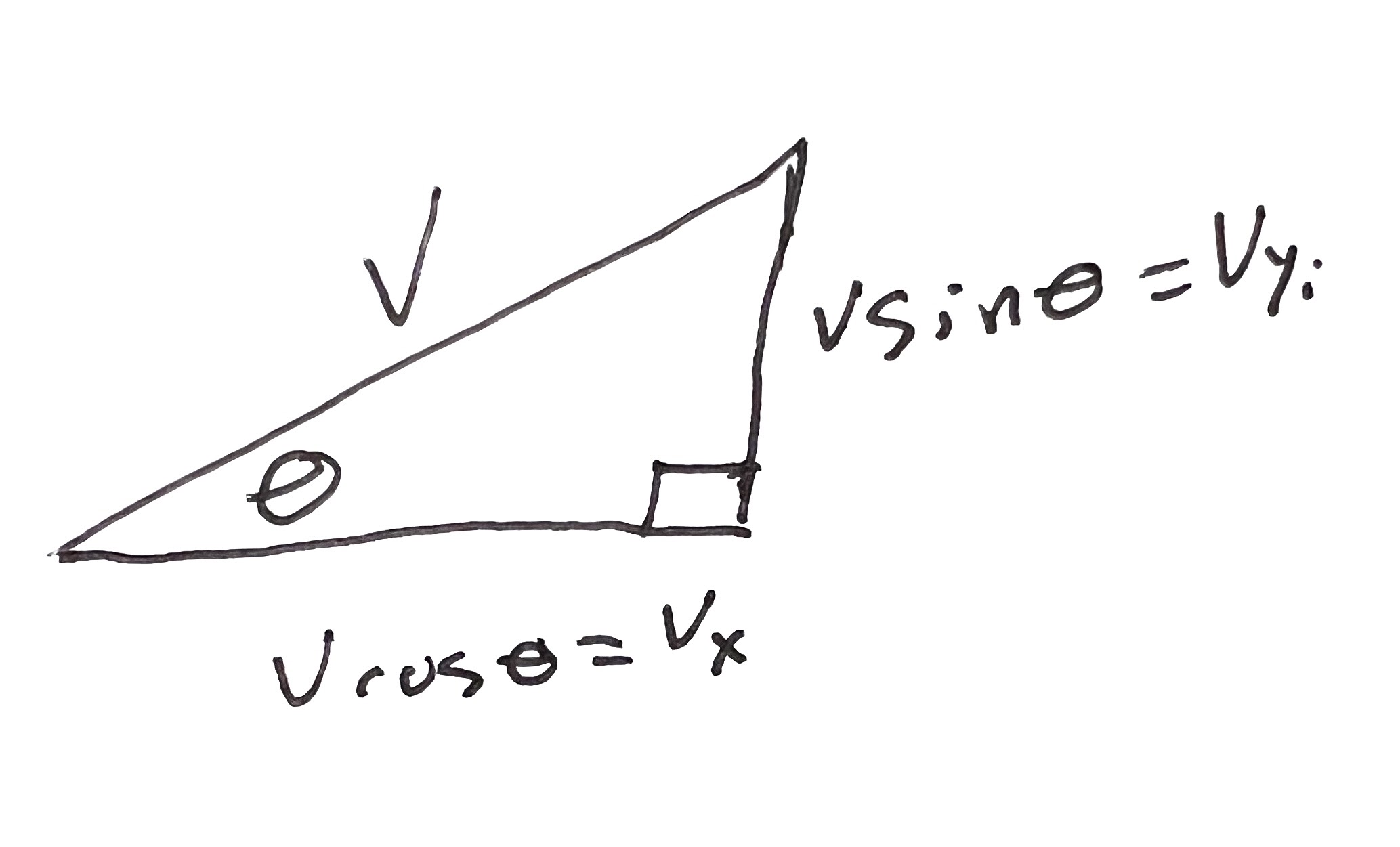
STEP 2: Find the y and x components of the velocity v where the angle is θ.


v • cosθ = vx
v • sinθ = vyi

Whereas the velocity up/down will change due to gravity, it will carry the subscript i for "initial." 

Whereas we are ignoring air resistance, vis a constant.


STEP 3: Find time up:

To find time up, use the velocity equation…

v= vi + at  
 
Plug in for the specific situation…
 
0 = vyi + (-9.81)tup
-vyi = -9.81•tup
-vyi /-9.81 = tup 
vyi /9.81 = tup 


Find time down:


To find tdown, you will need to use the distance equation:

df = di + vit + 1/2at2 

The most accurate way to think about this is to say df is the ground and di is the total vertical displacement, dy(max) which is how much the projectile went up (∆dy) plus the initial vertical displacement (dyi). Since these would be measured from the ground to the top of the trajectory, they would be positive meaning a is in the opposite direction and is negative. Further df would be when it hits the ground and would be zero.

Did you notice that, to find time down, we have to find max vertical displacement (which we'll call dy(max))?

To do that, we will ALSO use the distance equation, but with the value for tup which we found in Step 3. 

STEP 4: Find how high it goes.

We use that value, tup, in the distance equation to find how high it goes, dy(max).
df = di + vit + 1/2at2  
 
Plug in for specific case: 
 
dy(max) =  dyi + vyi•tup + 1/2at2 


STEP 5 Find time down

Now that we know how high it went, we can use the distance equation  AGAIN to find tdown with the following values.

df = 0 m (the ground)
di  = dy(max) 
v =  0 m/s (because we are measuring from when it stopped going up, max distance in y direction)
a = g = -9.81 m/s/s (or -9.8 m/s/s) 
t =  tdown


Solving for t we find that…

df = di + vit + 1/2at2 
0 = dy(max) + •  tdown  + 1/2(-9.81) tdown2 
 -dy(max)  =  -4.905 tdown2 
 -dy(max) /  -4.905 = tdown2 

The negatives cancel. Take square root of both sides:

tdown = √  (dy(max)) / 4.905


STEP 6: Find the total time:

ttot = tup + tdown


STEP 7: Find the horizontal displacement, dx:

Whereas…

di  = dxi = 0
v =  vx   (From Step 2)
a = 0
t =  ttot


df = di + vit + 1/2at2 
dx = 0 + vxttot + 0 
dx = vxttot


______________________________

By now, you will have noticed that there are a lot of steps and a lot to understand. 

Conceptually, it's not too hard:

The horizontal distance is how far it goes before it hits the ground, and is found easily:

dx = vxttot


"Before it hits the ground" (ttot) is how long it takes to go up added to how long it takes to come back down.

It is in the most complicated steps (3 and 4) that we find the "how long it takes".

Conceptually, it might help to partition off parts of your paper to do a few things…

1. Draw it out and find vx and vyi…
2. Make a box in which you will find dx (at the end of the process)
3. Figure out the time up and time down then go back to the box…


Once you get through the process conceptually a few times, you can fall into a "calculator" process (though you'll still need to write down some values as you go." Consider the checklist that follows…


CHECKLIST/SUMMARY

So, if you are given theta and the velocity, here's a checklist sort of process…

  • #1 Draw the diagram and label everything.
  • #2 Find the component velocities in the x and y directions:
v • cosθ = vx
v • sinθ = vyi


  • #3 Find the time up using vy and acceleration due to gravity (probably 9.81 m/s/s)
tup = vyi  / 9.81


     Find the time down: 

        • #4 Find how high it goes

    • First, find dy(max):
      dy(max) =  dyi + vyi • tup + 1/2•(-9.81)•tup2 

  • #5 Find time down
    • Then, find tdown:
tdown = √  dy(max) / 4.905 


  • #6 Find the total time where…
ttot = tup + tdown


  • #7 Use the distance equation to find the horizontal displacement: 

d= vxttot

where vx was found in step 2 and was found in step 4.


Something like this…


The scribbling above follows the steps without labeling them with numbers. Go down the left, the back up and down the right.


How about with colors?


CHECKLIST/SUMMARY

So, if you are given theta and the velocity, here's a checklist sort of process…

  • #1 Draw the diagram and label everything.
  • #2 Find the component velocities in the x and y directions:
v • cosθ = vx
v • sinθ = vyi


  • #3 Find the time up using vy and acceleration due to gravity (probably 9.81 m/s/s)
tupvyi  / 9.81


     Find the time down: 

        • #4 Find how high it goes

    • First, find dy(max):
      dy(max) =  dyi + vyi • tup + 1/2•(-9.81)•tup2 

  • #5 Find time down
    • Then, find tdown:
tdown = √  dy(max) / 4.905 


  • #6 Find the total time where…
ttot = tup + tdown


  • #7 Use the distance equation to find the horizontal displacement: 

dvxttot

where vx was found in step 2 and ttot was found in step 4.


About Me

My photo
Bill Snodgrass is a life-long teacher/mentor type who likes to see people develop into their best possible selves.